Ordinary Time – Cycle A

Fifth Sunday of Ordinary Time – Cycle A

4 February 2011

Reflecting on Matthew 5:13-16

Darkness. The ancients experienced it in ways we can’t imagine.  My friend Erin told me about a scary twenty minutes of her life in a blackout one evening while she was walking home from work in Oakland, California.  She was just a few blocks from her house when the street lights went dark.  (This, by the way, is the same city in which my cousin was murdered in daylight as she was getting off the city bus 18 years ago.)

All these years later, Erin remembers that penetrating darkness, how immediately she became uneasy, then jumpy, then terrified as she walked the dark neighborhood streets she knew so well.  The lights from an oncoming car brought a few seconds of clarity.  Of course! That scary figure up ahead is just the open gate to the neighbor’s yard! But then she was plunged into darkness again as the car sped away, and those familiar streets morphed into sinister hiding places for ugliness and evil.

Some people, as Thomas Merton said, are walking around shining like the sun.  Every encounter with them makes you feel warm and loved.  They are found everywhere, little rays of light adopting children from Haiti, helping gang members recover their lives, getting up at night with the sick baby, loving that troubled adolescent, joyfully teaching the grandchildren their prayers, sitting with the parent who has long forgotten their name, preaching the Gospel and sometimes using words to do it.

And here’s the best part about being the light of the world: Isaiah says that when you shall call, the Lord will answer.

Who are the people you know who bring light?

In memory of Patty Cronin, a light-bearer

What would YOU like to say about this question, or today’s readings, or any of the columns from the past year? The sacred conversations are setting a Pentecost fire! Register here today and join the conversation.

I have come to light a fire on the earth; how I wish it were already burning (Lk.12:49).
Fourth Week of Ordinary Time – Cycle A

29 January 2011

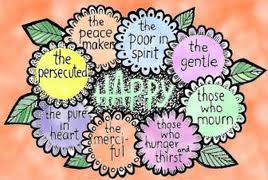
Reflecting on Matthew 5:1-12a

I’ve experienced the blessing of being poor in spirit several times.  There was the day I sang a whole wedding Mass with the back of my skirt hooked on to my pantyhose.  Or the time I chose a lovely silk smock from the hanger at the hair salon, and as the stylist was putting my head in the water an exceptionally kind older woman touched me on the shoulder and said, “Honey, I think you’re wearing my blouse.”

I could do this all day.  My life is a series of horrible moments that have brought me this self-revelation: I am just faking it here.

And that’s the blessing.  The kingdom of God is just this: a deep and joyful awareness that God is God, and I’m not.  Scripture scholar Reginald Fuller said, after studying today’s reading from Zephaniah and the Gospel’s Beatitudes, “on the day of the Lord the only ground of security is humility.”  Not self-hate.  Not breast-beating.  Just the awareness that, at any moment, the world will see that We are just faking it here. But God upholds us and strengthens us.

Try to bring back an embarrassing experience.  Hold it.  Let it take your breath away again.  Bow your head under its terrible weight.  And now wrap it around you as a warm coat, a safeguard against the cold winds of assurance, arrogance, superiority, dominance.  And let the blessing warm you like a peppermint schnapps’ by the fire.  God is God and you aren’t.  Whew.  What a huge relief.   What a burden lifted.  What a blessing.

In what ways has a humbling experience blessed you?

What would YOU like to say about this question, or today’s readings, or any of the columns from the past year? The sacred conversations are setting a Pentecost fire! Register here today and join the conversation.

I have come to light a fire on the earth; how I wish it were already burning (Lk.12:49).
Third Sunday of Ordinary Time – Cycle A

22 January 2011

Reflecting on Matthew 4:12-23, I Corinthians 1:1-3

What would it be like to just leave it all behind?  Say, for example, that you and your brother were in your father’s fishing boat, mending the nets, and the Rabbi came close to your boat and called you each by your name?  What would it be like to just jump off the boat and go with him?

They left their nets behind

Or what if you were a tax collector for the Romans, counting two for them and one for you, and the Rabbi passed by your booth?  What would it be like to just walk away, with the chips still on the table?

Or what if you were in the middle of an argument with your kid, and you were right and she was wrong, and this was finally your chance to wipe that smirk off her face, and instead the Rabbi looked straight into your heart, and you just stopped, and held your tongue, and actually listened―actually heard her and put yourself into her world and her place of powerlessness?

Or what if somebody liked to talk about his candidates and his take on immigration reform, and instead of feeling your heart rate go up and your face getting red, instead of saying I’m for Obama! or I’m for Palin!, the Rabbi entered the room, and you saw and felt the fears and frustrations of your friend, and you walked away from the argument and walked into an actual, real friendship based on real listening and real hearing?

What if the Rabbi was walking toward you right now, calling your name?  My guess is that, if you’re reading this, he already has.

In what ways do you feel yourself bending to the will of the Rabbi?

What would YOU like to say about this question, or today’s readings, or any of the columns from the past year? The sacred conversations are setting a Pentecost fire! Register here today and join the conversation.

I have come to light a fire on the earth; how I wish it were already burning (Lk.12:49).
2nd Sunday of Ordinary Time – Cycle A

17 January 2011

Reflecting on John 1: 29-34

In this first post-Christmas week it’s fun to think about the dates the Church has chosen to remember the conception and birth of both Jesus and Mary.  The Feast of the Annunciation is March 25th, so of course Jesus is born a perfect nine months later. Mary’s birthday of September 8th is a perfect nine months after her immaculate conception on December 8th.  Ah, yes.  Isn’t that how all pregnancies end, with a birth just exactly nine months later?

That I may decrease, and he may increase.

Since the real dates of these events are unknown, the Church used the opportunity to teach certain theologies.  One of the loveliest moments in the liturgical calendar is the feast of the birth of John the Baptist, that key New Testament figure whom the Gospel lingers over again today.  Since Mary visited Elizabeth when her cousin was six months pregnant and stayed three months until the birth (Luke 1:26-56), that puts the birth of John the Baptist (June 24th) right around the summer solstice.  So, as the days begin to decrease the great herald comes into the world―that I may decrease, and he may increase―and as the days begin to increase (December 25th) the Light to the nations is born.

I love it when scripture and the liturgical year kiss.

What would YOU like to say about this question, or today’s readings, or any of the columns from the past year? The sacred conversations are setting a Pentecost fire! Register here today and join the conversation.

I have come to light a fire on the earth; how I wish it were already burning (Lk.12:49).

« Previous Page