Ordinary Time – Cycle A

Presentation of the Lord – Cycle A

3 February 2014

Reflecting on Luke 2: 22-40

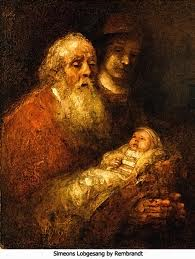
Rembrandt, Simeon in the Temple, 1669

Even though we are reading from the gospel of Matthew this year, today’s feast falls on a Sunday and therefore trumps the Ordinary Time readings.  Since two female saints, Mary and Anna, are featured in the account, you can bet that Luke is the author.  He loves to tell us stories about women, especially Mary, and we love to hear them.

This story is all about timing.  Mary and Joseph waited the prescribed forty days and then entered the Temple.  Simeon was led by the Spirit to go there that day, and Anna purposely placed herself in the Temple every day so that she could bear witness to God’s perfect timing.

Have you ever been at the right place at the right time? So often it’s only in looking back that we recognize the perfect timing that led us to our spouse, or to our friends, or to faith itself.  But much of “perfect timing” has to do with aligning ourselves with grace.  Mary and Joseph complied with the Law.  Simeon complied with the Holy Spirit.  And Anna complied with her inner knowledge that if she was to see her Savior she needed to stay in the Temple.

We live our lives immersed in mystery.  We are astounded at the perfect timing of many events in our lives.  Somehow, we intuitively sense the Divine, and situate ourselves to be receptive to the presence of Christ, visible and invisible.

It’s in that patient day-to-day watchfulness that our lives unfold.  And one day, in God’s own time, we too will say:  Lord, dismiss your servant in peace, for my eyes have seen your salvation.

What moments of “perfect timing” have you experienced?

What would YOU like to say about this question, or today’s readings, or any of the columns from the past year? The sacred conversations are setting a Pentecost fire! Register here today and join the conversation.
I have come to light a fire on the earth; how I wish it were already burning (Lk.12:49).

Third Sunday in Ordinary Time – Cycle A

26 January 2014

Reflecting on Matthew 4: 12-23

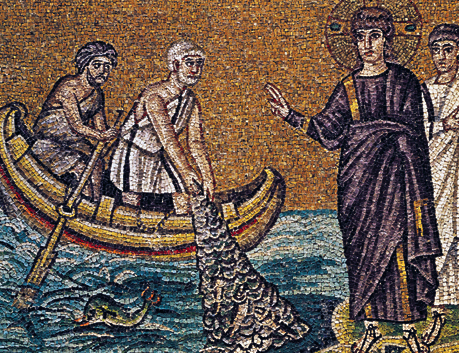
The Calling of Saints Peter and Andrew, from the Church of Sant’ Apollinare, Ravenna, Italy

And so it begins.  The Spirit hovers over Jesus, and announces his identity as God’s own Son. Soon afterwards, John is arrested and shut up in prison.  It is time, the time marked out from the beginning of time.  Jesus the Christ moves away from the comfortable Jewish neighborhoods of Nazareth and launches the Age of Grace in the Galilee of the Gentiles.

The people who walked in darkness now see a great Light.  His name is Jesus, and he is living, and preaching, and healing among them.  And he is calling them out of their boats into the greatest fishing adventure of all time.

Sometimes you just know that it’s time.  Time to grow up.  Time to move away.  Time to put away childish behaviors, petty resentments, unhealthy habits, and immature ideas about God that keep you at a safe (but so unsafe) distance from the One who is God with us.

The distance between Nazareth and Capernaum was only 48 miles.  Sometimes the greatest journeys we take are the shortest in distance, but in looking back we say, “Yes, that’s when my life changed forever.”  Jesus knew it was time to stretch out his arms to every person, Gentile and Jew, to heal and console, to catch all creation in his safe embrace, and let anguish take wing.

In time, those healing arms would be stretched out on a cross.  Did he know that when he left tiny Nazareth to catch Peter and Andrew and James and John in the net of eternity?  He caught us too, of course.  We live in gratitude for that, and hope to be his best catch ever.

What has been a significant time of transition in your life?

What would YOU like to say about this question, or today’s readings, or any of the columns from the past year? The sacred conversations are setting a Pentecost fire! Register here today and join the conversation.
I have come to light a fire on the earth; how I wish it were already burning (Lk.12:49).

Second Sunday in Ordinary Time – Cycle A

19 January 2014

Reflecting on John 1: 29-34

I did not know him. That’s quite a confession, especially coming from John the Baptist, the very one sent to herald his coming.  Even John did not know him, but the day that Jesus appeared in Bethany across the Jordan all the mysteries of John’s life finally came into focus for him.

Ah.  It was for this that I cried out in the wilderness.  It was for this that I lived a celibate, ascetic life.  It was for this that I stood in the river and baptized.  It was for this, to proclaim him and know him, that I was born. (And it was for this that John, shortly afterwards, would speak truth to Herod, and be martyred.)

Maybe you feel like John.  You are working hard.  You are volunteering.  You are raising a family, coaching the volleyball team, teaching the kids their prayers, and praying them yourself with all your heart.

Or maybe you’re retired now.  Or widowed.  Or never married.  And you still make your Morning Offering as you always have:  Here am I, Lord.  I come to do your will.

Like John, you keep showing up for the life God has given.  Sometimes you wonder if your prayers will ever be answered.  Sometimes you wonder why a life of faithfulness to Him seems to mean so little to anyone else.  But every once in a while you experience that spine-tingling grace of recognition: Christ, the One for whom your heart longs, is right here with you.

And the Spirit hovers.

In what ways do you “show up” for your life in Christ?

What would YOU like to say about this question, or today’s readings, or any of the columns from the past year? The sacred conversations are setting a Pentecost fire! Register here today and join the conversation.
I have come to light a fire on the earth; how I wish it were already burning (Lk.12:49).

Feast of the Baptism of the Lord – Cycle A

12 January 2014

Reflecting on Mt. 3: 13-17

Sometimes I find a word that seems to follow me around until I pay attention to it.  For many years now that word for me has been “yield”.

Yield.  It’s a word so full of grace that we need to just lean into it, just rest with it and let its mysterious comfort seep into us.  What would it be like if we allowed ourselves to yield in our family relationships and, mercifully, allowed each of our flawed siblings and parents and children to just be themselves?  The truth is, in a thousand ways unknown to us they have yielded in their desire to change us over the years too.

Jesus began his public ministry not by teaching or healing, but by yielding.  He yielded to the chilly waters of the Jordan, though before the beginning of time he shaped the mountains whose snows would feed that river.  He yielded to time and place and asked John to baptize him, though John was astonished that the sinless One would allow such an irony.

John had to yield too.  He would have much preferred to be baptized by Jesus, but he “allowed” it, he yielded to it, because Jesus asked him to.  He immediately received the graces from yielding, because then he witnessed the heavens opening and the announcement of Jesus as the Beloved Son of God.

Is there a chronic sadness or dis-ease in your life because you keep going over and over the mistakes you’ve made, or the injustices you’ve experienced, long ago?  Aren’t you tired yet? Try giving up the struggle.  Yield.  And then watch peace flow like a river.

Have you experienced a recent grace from “yielding”?

What would YOU like to say about this question, or today’s readings, or any of the columns from the past year? The sacred conversations are setting a Pentecost fire! Register here today and join the conversation.
I have come to light a fire on the earth; how I wish it were already burning (Lk.12:49).

Solemnity of the Epiphany of the Lord – Cycle A

4 January 2014

Reflecting on Mt. 2: 1-12

Lately, I’ve been playing some brain games from Lumosity.com. I like the one that challenges me to look at things differently in order to solve a puzzle.  When I try to solve it from my narrow perspective I lose.  But when I open my eyes to a new direction, suddenly the solution appears, and is so easy that I wonder how I didn’t see it before.

The Magi were great at that.  They were probably Persians, searching the skies for astrological signs, when they saw this compelling Star, and were so drawn to it that they left everything to follow it for two years.  And where did it lead them? Far away, into the heart of Jerusalem.  That must be why they surmised that the star was announcing the newborn king of the Jews.

Talk about openness.  They weren’t Hebrews, but were willing to change the direction of their lives in order to find this Jewish King and pay him homage.  Then, overjoyed at finding him in Bethlehem, they paid attention to their dreams and changed directions again, going back home another way in order to give the Holy Family a head start in their flight away from Herod and into Egypt.

Thirty-three years later, the orthodox, Law-abiding Saul of Tarsus encountered that same Jesus, now risen and ascended, as a Light whose blinding brilliance stopped him in his tracks.  He left the road to Damascus and changed the direction of his life, and thus the direction of the history of the world.

Are you looking for a new path for your life?  Ask him whose birth was heralded by a Star to shine the Light in your direction.

What dead-ends do you want to stop following this year?

What would YOU like to say about this question, or today’s readings, or any of the columns from the past year? The sacred conversations are setting a Pentecost fire! Register here today and join the conversation.
I have come to light a fire on the earth; how I wish it were already burning (Lk.12:49).

Solemnity of Christ the King – Cycle A

20 November 2011

Reflecting on Matthew 25:31-46

And so the year ends as it began.  Last Advent we began this year of Matthew by reading the account of the angel who appeared to St. Joseph in a dream, telling him that Mary had conceived a child through the Holy Spirit.  And this was to fulfill what the prophet Isaiah had spoken, that a virgin would conceive and bear a son, whose name would be Emmanuel, which means God with us.

And all year long Matthew told memories of Jesus that brought that truth home over and over again.  The poor in spirit, the peacemakers, those who mourn—God is with them!  Those who ask, and seek, and knock—God is with them!  Fishermen, and Canaanite women, and tax collectors who leave it all behind to follow Jesus—God is with them!  And even workers who come to the fields very late in day come to know that God is with them too.

And now, at the Final Judgment, the greatest of all secrets is revealed: He is not only with us, but He has become us. Through his Incarnation in us he has actually become one with us.  He has so embedded Himself with us that when others see us in our brokenness they are looking at Christ Himself.

Lord, when did we see You?  When we were sick and found comfort, unemployed and found work, at a dead end and found the way out, was that You? Ah.  So it was You all along, healing us through Your Body on earth and in heaven.  And behold, You are with us always, even unto the end of the age.

When did someone see you when you needed them to?

What would YOU like to say about this question, or today’s readings, or any of the columns from the past year? The sacred conversations are setting a Pentecost fire! Register here today and join the conversation.

I have come to light a fire on the earth; how I wish it were already burning (Lk.12:49).

Thirty-third Sunday in Ordinary Time – Cycle A

13 November 2011

Reflecting on Matthew 25:14-30


Boy, it’s hard to hear the Gospel today and not applaud the third slave who was savvy enough to bury his one talent so at least he had that to give back to his master.  With pensions gone and 401Ks vanished and wise investments brought to ruin, who doesn’t wish they had buried their money in a field somewhere, ready to be dug up when times get tougher?


Parable of the talents (John Morgan, 1823-1886)

But I also root for the third slave because I think he suffers from a deep insecurity, or maybe an anxiety disorder, that keeps him from putting himself out there and taking a risk.  How many people do you know—or maybe it’s you—who are paralyzed in some place in their lives?  For so many people the daily struggle to just make eye contact, say hello, and make their way in our extroverted society is a challenge that leaves them exhausted by day’s end.

Or recall Vincent, whose immense brilliance compelled him to capture beauty in its thousands of manifestations on his canvasses.  But tortured by anxiety and self-doubt, he finally yielded to that starry night where his art could torture him no more.

It’s risky and painful to put yourself out there, but in the most important race of all it’s crucial that you show up. Today Jesus is urging us to take every risk, use every single opportunity to secure the Kingdom of Heaven.  Love, and more love will be given you.  Have faith, and more faith will take root in you.  Be rich in hope, and more hope will abound.  That’s the simple Math of the Kingdom of God.

In what ways does your daily investment in love pay great dividends?


What would YOU like to say about this question, or today’s readings, or any of the columns from the past year? The sacred conversations are setting a Pentecost fire! Register here today and join the conversation.

I have come to light a fire on the earth; how I wish it were already burning (Lk.12:49).

Thirty-second Sunday in Ordinary Time – Cycle A

5 November 2011

Reflecting on Matthew 25:1-13

We’re coming near to the end of the liturgical year, and boy can we feel it.  Paul warns about trumpets sounding and God’s voice resounding through archangels.  And then of course we have this parable of the ten virgins, all anxious for the (late) Bridegroom, but only five are prepared for His coming.  Yes, the end-of-the-world readings are screaming for our attention.

But I want to recall a scene in The Hiding Place, one of the most powerful books written about those who lived and died during the Holocaust.  Corrie ten Boom, her sister and their father had been hiding terrified Jews in a secret upstairs closet in Corrie’s room in Amsterdam.   Corrie, organized and thoughtful, had prepared a bag for herself, with aspirin, a change of clothes, and some small crackers to comfort her when she inevitably fell into the hands of the Nazis and was taken off to the camps.

But the night that the (always punctual) Germans showed up at her house, screaming and pounding and demanding entrance, those who were being hidden leapt into the secret room while Corrie threw her bag in front of the closet.

And when they dragged her away, already feverish with influenza, she left her bag behind.  She couldn’t take the chance that an errant piece of clothing was hanging outside the closet, a clue that would have ended in death for all who had sought safety with her.

And she saved them all. How?  By heroically sacrificing her own preparation for those who could never prepare.  And I’ll bet that, at the moment of her death decades later, the Bridegroom took her straight away into the Wedding Feast.

In what ways have you prepared to meet the Bridegroom?

In loving memory of Sr. Antonia Anthony, OSF, whose happy death on November 4th, surrounded by the Marycrest Franciscans and her family, helped an entire wing at Denver Health sense that the Bridegroom had come for her.

What would YOU like to say about this question, or today’s readings, or any of the columns from the past year? The sacred conversations are setting a Pentecost fire! Register here today and join the conversation.

I have come to light a fire on the earth; how I wish it were already burning (Lk.12:49).

Thirty-first Sunday in Ordinary Time – Cycle A

30 October 2011

Reflecting on Matthew 23: 1-12

Don’t you love people who do wonderful, holy things every day, out of the sight of the rest of us?  Every once in a while we might accidentally catch them doing good, and I think it’s important that we do.  How else can we be edified and inspired if we never know that they are companioning an elderly neighbor through his last months in hospice, or loving and comforting a mentally ill spouse, or singing and dancing with a beautiful child backstage for four hours before she walks down the runway with Ed McCaffrey in the Down Syndrome Fashion Show?

There’s really no other possible explanation for the heroic things that average people do every day except for this: they are in love.  They have let themselves fall deeply in love with Love, and out of that collision has come hospitals, schools, shelters, food banks, foundations, and the spouse who, less than a year after her own mother’s long goodbye, now helps care for her husband’s mother as she begins that same journey.

Parents are the most inspiring example I can think of, especially those with children who are, how to say this, challenging?  Love is patient and kind, believes all things and hopes all things. Is there anything more beautiful than parents who believe and hope and love their children through the awkwardness of adolescence?

Let’s take a second to just let all that goodness pour over us and into us and out from us. It’s hard to be inspired by the Pharisees, who put their good works on display.  How sad.  Because our true measure is who we are when no one’s looking.

What example can you give of someone who is heroic in silent, small ways?

For Fred,  Lynda, Delane, and Mary

who continue to inspire after all these years

What would YOU like to say about this question, or today’s readings, or any of the columns from the past year? The sacred conversations are setting a Pentecost fire! Register here today and join the conversation.

I have come to light a fire on the earth; how I wish it were already burning (Lk.12:49).

Thirtieth Sunday in Ordinary Time – Cycle A

22 October 2011

Reflecting on Mathew 22: 34-40

The challenge today to love our neighbor as ourselves is, as one clever writer put it, “like sand in your swimsuit”.  You can squirm and wiggle and try to re-position yourself, but that sand isn’t letting go until you deal with it.

Moses, painting by Jusepe de Ribera 1591-1652

Do we have enough resources between us all to let others matter to us as much as they matter to themselves? I think so.  Let me tell you about the members of the St. Vincent de Paul Society, who’ve heard and seen it all and still dig deep within themselves to listen carefully and lovingly to those most in need of mercy.

Let me tell you about Portland researcher Dr. Brian Drucker.  Way back when he was in medical school he looked at chronic myelogenous leukemia and said, “I’m going to cure that”.  For twenty years he worked almost obsessively, even enduring the ridicule of his peers at a conference where he presented his approach to a cure.  But he let his patients matter to him as much as they mattered to themselves. And in 2001 Dr. Brian Drucker brought the chemotherapy drug Gleevec to market, the only true cancer breakthrough in our lifetimes.

Let me tell you about the Colorado Vincentian Volunteers, a group of twenty-somethings who give a year of service to children, teenagers and adults in Denver—precious human beings who long to matter to someone as much (or more, sometimes) as they matter to themselves.

Can you remember the times when you received that kind of love?  When someone really listened to your story and cared?  Really noticed your pain and helped take it away?  That’s what the laws of Moses, which Jesus is quoting in today’s Gospel, are demanding. 

 Or as Rabbi Hillel famously said,  “The whole Torah can be taught while standing on one leg: That which is despicable to you, do not do to your fellow.  This is the whole Torah, and the rest is commentary.  Go and learn it.”

In what ways have you mattered to someone as much as you matter to yourself?

In memory of Patty and Len Langenderfer.  Vincentian to the core, they simply noticed the needs of people whom they knew God had placed in their paths.  And nothing has been the same since.

What would YOU like to say about this question, or today’s readings, or any of the columns from the past year? The sacred conversations are setting a Pentecost fire! Register here today and join the conversation.

I have come to light a fire on the earth; how I wish it were already burning (Lk.12:49).

« Previous PageNext Page »