
Twenty-Eighth Sunday in Ordinary Time – Cycle B
Reflecting on Mark 10:17-27
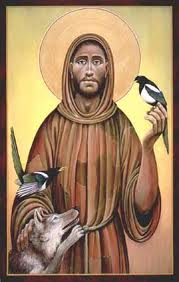
Every so often I have to read another book about St. Francis of Assisi. Eight hundred years later his story of utter conversion, utter transformation into the very heart of Christ, still stuns me. This year’s book is Julien Green’s wondrous God’s Fool: The Life and Times of Francis of Assisi.
Using the oldest documents we have about him, Green brings into startling focus the life of the world’s greatest saint. This charming, devilish “Prince of Youth”, leading his drunken friends through the streets of 13th century Assisi, had a beautiful singing voice and the refined appetite for elegance and fine dining that befit the son of a wealthy clothier. And then, like St. Paul, God met him on the road one night:
Stuffed to the point of vomiting, the guests went off to defile the public squares with their drunken songs. And who was that following them, with his fool’s baton in hand, but Francesco, the king of the feast? All of a sudden he stopped.
What had happened? In the middle of that sorry feast, Francis had fallen in love. For years he had been fleeing someone or something, and suddenly that Someone had caught up with him and blasted him with all the power of his tenderness. Francis was twenty-five years old.
Within weeks of that encounter Francis sold everything and gave it to the poor. Overjoyed and filled with the utter fullness of God, he found the treasures of heaven.
As I read this book I drew as closely to him as I dared, and caught a glimpse of those treasures. And now comes today’s gospel, with its warnings against wealth (and I confess I love wealth) because it can distract us from drawing as near as we can to Christ. Help! The Hound of Heaven is chasing me.
Do the greatest joys of your life have anything to do with money?
What would YOU like to say about this question, or today’s readings, or any of the columns from the past year? The sacred conversations are setting a Pentecost fire! Register here today and join the conversation.
I have come to light a fire on the earth; how I wish it were already burning (Lk.12:49).










I use think that God was unfair, why do the humm, the most dreadful women get husbands and I can’t even get a look. I was so angery and hurt I felt like God had forgot me. But as I now look back at each person I felt could be”Mr. Right” And I see what poor choices I made I’m amazed how I was spared the pain of abuse. I have had a different call then being a wife and mother, I have been called to take care of the sick and dying. I didnt have much of a childhood, I grew up fast, but not always wise. I have learned that the labor of love comes in all sort of relationships. people ask if I regret not marrying or having babies. No not really, I have had a full life with memories that I hold dearly to my heart. I’m proud that I was there to hold the hand leaving this life and I am proud that I raised my brother and sister otherwie we would have been split up amongst the different relatives. Gods call for me has been intimate and rewarding all I ever had to do is stop feeling sorry for myself and realize I am Blessed by God in my call to do the thing I have done. I am not anti marriage or anything I just never fit that roll and I never had time. It would have been so unfair to a husband, he may have been put last all the time. I just wish I had learned these things younger and embraced the life I led at the each stage of the life I lived.
By necessity, I focus on the first part of God’s declaration in this reading: “It is not good for the man to be alone.” Everything else that is narrated in the second creation account flows from that simple truth. And so it seems ironic that this story has often been used as the foundation for a so-called biblical argument that would forbid people like me from seeking the “suitable partner” who would complete our lives.
God intended us to love. It’s that simple.
Even the Catechism of our church affirms that this is so: “Love is the fundamental and innate vocation of every human being” 2392.
We find this connection, this oneness, in many ways. Those ways are sometimes imperfect or transitory, sometimes sublime and irrevocable, but always based on that central impulse to belong to someone besides ourselves, as God intended.