Fourth Sunday of Lent – Cycle A

2 April 2011

Reflecting on John 9:1, 6-9, 13-17, 34-38

It’s the last line of today’s Gospel that’s the real zinger.  Jesus, you’re not suggesting that we are the ones who are blind, are you?  Because we know how God has set up the world.  Good things happen to good people, and bad people are blind from birth.  Okay, maybe this guy isn’t directly responsible for his blindness, but his parents must have been sinners, right?  And we know for sure that YOU are a sinner because you brazenly heal on the Sabbath!

Isn’t their response a little similar to ours when we hear about something terrible that has happened to someone we know?  Yes, it’s terrible that she has lung cancer, but she probably smoked, and I don’t smoke, so I’ll never get lung cancer. Yes, it’s horrible about the car accident, but I’ll bet he wasn’t wearing his seat belt, and I always wear my seat belt, so I’ll never be in a car accident.

There is something in us that needs to find a reason why bad things happen to very good people, because it’s too terrifying to admit that they could happen to us too. And if we can admit that, perhaps we are also ready to acknowledge that God can shake us from our cynicism, peel away our layers of bravado, and actually heal us too.  It’s not a trick.  It’s not a plot hatched years ago to make us think the man was blind when he really could see all this time.  His parents weren’t in on it, and he wasn’t in on it.  That man they call Jesus touched him, and now he can see.

And if we can’t believe that, we are more blind than the man who was born blind and now sees.

In what ways have you felt the healing touch of Jesus in your life?

What would YOU like to say about this question, or today’s readings, or any of the columns from the past year? The sacred conversations are setting a Pentecost fire! Register here today and join the conversation.

I have come to light a fire on the earth; how I wish it were already burning (Lk.12:49).

7 Comments to “Fourth Sunday of Lent – Cycle A”

  1. We are often blinded by the light of our own supposed enlightenment. Our education, our sense of self-worth, our jobs and our sense of entitlement blind us to the fact that we are not self-sufficient, are not saved by our own devices, are not so strong that we don’t need to kneel in worship to something greater than ourselves. Only the light of Christ and the grace of God can pierce both the darkness of the world and the overwhelming light of our own egos.

    Steve Givens
    http://www.givenscreative.com

  2. There are physical eyes that see objects, like tables and chairs; there are eyes of the mind that understand explanation, such as where thee is smoke, there’s fire ; then there are the eyes of the heart that gradually learn to see only after being formed in the school of compassion.

    Cris

  3. There have been times in my life when I was “blind,” where I had gotten myself into a mindset of anger at some situation, and was unwilling to put it in the past.
    Looking back, it was those times when Jesus felt the closest. Close, looking at me, asking me to change my heart and view, and holding me close, assuring me that I am loved.
    Erin

  4. Our parish recently hosted the Franciscan Mystery Players who performed a meditation called Jesus the Healer. It was a heart moving experience and I cried almost the entire time. (Kathy, you know how that can happen.) The sanctuary became the stage, set in a semi-darkness, lights focusing on the actors. There was a narrator and voices for Jesus and the various characters. Because their faces were often hidden and their bodies told so much, it was important to watch the physical gestures of the actors. It could be anyone. It could be me! Jesus hung on the cross remembering his life encounters with those who were wounded and sick and “asleep.” He healed each of them in their most needed places, deep in their souls. And then there was the embrace. Person after person clung to Him whose arms were wrapped around the individual. They weren’t quick hugs but the kind that manifests a longing and a connection, the kind that says, “I have found home.” My eyes were opened, my heart was warmed, my soul was held. A great wound within me was being touched by an incomparable Mercy, Love and Compassion. There was nothing about me that God did not love. I saw anew who this God is in my life. Once again, blindness is removed

  5. I woke up this morning on what would have been my second son’s 39th birthday. I went to the Mass at our parish, which I had scheduled for him. I thanked God for the great gift He gave me 39 years ago and prayed for the repose of my son’s soul and his happiness in heaven.

    God healed any bitterness I might feel because of the deaths of both of my sons, my only children, by showing me what great gifts they were to me and how fortunate I was to be their mother. Now, I’m not saying that I’m never sad or that I don’t miss them every day — I do — but the grace God has given me to be happy that I had them both in my life (even for too short a time) is a great healing that helps me deal with the losses in a positive way.

    http://www.todaysepistle.com

  6. I have felt the healing touch of Jesus in my life when I finally let go of the pain and bitterness that I felt after a failed marriage. When I was able to forgive, then my own heart healed. Only when I was able to let go of my misery, did I feel the gentle touch of Jesus who was walking with me all the time.
    Brebis, thank you for sharing your story, it touched my heart!
    Also as Bobbie mentioned, if anyone has the chance to see the Franciscan Mystery players, what a beautiful meditation!

  7. Brebis,
    Thank you for sharing your story. I downloaded it to share your courage with my wife.

    God bless you.

    Cris

Leave a Reply

You must be logged in to post a comment.

Third Sunday of Lent – Cycle A

26 March 2011

Reflecting on John 4: 5-15, 19b-26, 39a,40-42

One Sunday three decades ago I was distraught over the collapse of the strong parish community I had enjoyed for over a decade.  A new pastor had come in, and a better preacher had been installed in the parish down the road.  Within a few months the vibrant, warm, packed-to-the-gills Sunday Masses had deteriorated, and most of the friends with whom I shared Sunday had moved to the other parish.  It was so painful.

This particular Sunday I stopped by to visit a friend.  He did then, and still does to this day, spend the early morning hours in prayer with the Scriptures.  We talked for awhile about the dwindling numbers and the lackluster preaching, and then we fell silent for a few minutes.

What are you reading today? He looked down at the Bible on the table, open to the fourth chapter of John’s Gospel, and read the Samaritan woman’s challenge to Jesus:   Our ancestors worshiped on this mountain, but you people say the place to worship is Jerusalem.

Huh.  So questions about who’s got the best parish have been around at least since the day Jesus went out of his way to find that heartbroken woman, in the heat of the day, at a well that her great ancestor Jacob had dug.  He invited her into friendship with himself, and she left everything behind to tell the world about him.  Now that’s true worship, in Spirit and in truth.

Sharing God’s Word at Home:

Are there ways that you can build up your parish and the worshipping community?


What would YOU like to say about this question, or today’s readings, or any of the columns from the past year? The sacred conversations are setting a Pentecost fire! Register here today and join the conversation.

I have come to light a fire on the earth; how I wish it were already burning (Lk.12:49).

6 Comments to “Third Sunday of Lent – Cycle A”

  1. I’ve learned my lesson and today I simply focused on my small faith sharing group hoping that some of them would catch the ‘renovating spirit.’ And some did. A couple of them took off and form their own lenten group aside from our primary prayer group. The metrics of macro-organizational expansion has value but is not the exclusive value. – – Cris

  2. This morning, I went to our 7:30 Mass, only to find that none of our three priests are in town this week, and the priest who was supposedly scheduled didn’t show up. There were about seventy parishioners in attendance. Fortunately, there were consecrated Hosts in the tabernacle, so I did a Communion Service.

    According to many comments afterwards, my community was happy that someone stepped up to do the Communion Service. Everyone would have had a day that didn’t begin with the reception of the Eucharist. I am so glad that I was able to do that for them. I believe we are stronger as a community when we begin each day together praying and receiving the Body of Christ, who then helps us be the body of Christ!

    http://www.todaysepistle.com

  3. I agree that it is very important to support our priests and our church, rather than complain about what doesn’t work for us, or running off somewhere else. After all, we are a church family and need to be there for each other.
    However, my faith grows stronger and matures more when I am given insight from the priest’s homily, or another speaker at our church. What if we are not being challenged in our faith because our priest gives very weak homilies? I do a lot around church and am ministered to by the lives of close friends in the church, and I am also leading a group study, but I feel like I need more (spiritual) food for thought from our priest…

  4. Susan,

    I understand your frustration. Perhaps Kathy’s questions on this website can help with the need for spiritual food for thought. There are also many books on the lives of the saints, and all kinds of books written by our popes, archbishops and bishops. I look for the pastoral (compassionate) qualities in the priests. If they also give good and thoughtful homilies, I count that as a bonus.

    http://www.todaysepistle.com

  5. Since my Lenten resolution is to not complain about church, I’ll try not to. Sometimes, however, I feel like I live in a parallel universe. I’m a cradle Catholic who has lived through the dynamic experience of Vatican II. I love the use of the vernacular, so when Latin shows up during liturgy, I wonder where I am. My personality calls me to ministry and to involvement in liturgy, so I have to participate to the fullest, even though I am a woman. When I am not being “fed” during the homily, I give about ten minutes to listening before I pick up the Breaking Bread book, open it to the Scripture of the day, and pray what I read. When all the additional artwork reflecting someone’s personal piety keeps showing up in our parish church every week, I close my eyes to the feeling of overwhelming distraction and examine the many judgments and opinions that arise in me. Sometimes it’s only my sense of humor and the hope that God knows my heart that saves me.
    How I build community flows from my own personal growth. I listen to the people with whom I worship during Mass. For them I try to be positive though often enough I think the same way they do. It causes me to reflect and find something that feels life giving. I also go to a Christian women’s bible study every week where I can offer my reflections and share in breaking open the word. The ecumenical contemplative prayer group to which I belong nourishes my soul in the quiet and in the way we pray as community. I bring this to Mass and stand in faith with all those present, letting their faith strengthen me when I feel lost or helping them stand when faith is difficult for them.

  6. Bobbie,

    We had a pastor a few assignments ago who stayed for twelve years. His contribution was to show us “The Dark Night of the Soul” that St. John of the Cross described. Mother Teresa, according to her journal, also experienced this phenomenon for many years. I am certain that she had many experiences of not being “fed.”

    Christianity isn’t how we feel; rather, it’s how we act in spite of how we feel. I admire Mother Teresa because she lived her Christian life without hearing any affirmation from God! That’s faith.

    http://www.todaysepistle.com

Leave a Reply

You must be logged in to post a comment.

Second Sunday of Lent – Cycle A

19 March 2011

Reflecting on Genesis 12:1-4a

All we ask you, God, is to speak as clearly to us as you did to Abram.  Tell us to get up and wander to a new land.  We’ll pack today.   Send us down to Egypt during a famine and we’ll book our flight.  Show up at our door with two angels at your side and we’ll rush to make a huge meal for you.  Just speak to us, God.  We’re so confused.

I will make of you a great nation

How does one discern the will of God?  God speaks to us through our own history, our memory, our understanding.   St. Ignatius of Loyola counsels us to notice what gives us peace, what gives us energy, what makes us unhappy, or burdened with guilt.  To paraphrase the old physical therapist joke, Does it hurt when you are cynical, or selfish, or lazy?  Then stop doing that.

Does it feel good when you end a conversation that is sliding into gossip and meanness?  Do that some more.  Does your spirit rejoice when you are the first to apologize, or to reach out for reconciliation?  I suspect you have wandered into the very heart of God.

Like Abraham and Sarah, we sojourn in a land that God unveils to us throughout our lives.  It’s a land marked by mistakes and bitter regrets, but shot through with grace and gradual healing.  Pay attention to what makes you truly happy, truly peaceful.  Abraham, at 75, lived one hundred more years after he discerned God’s call.  Let’s all keep listening.

At what times do you feel the most connected with God?

What would YOU like to say about this question, or today’s readings, or any of the columns from the past year? The sacred conversations are setting a Pentecost fire! Register here today and join the conversation.

I have come to light a fire on the earth; how I wish it were already burning (Lk.12:49).

12 Comments to “Second Sunday of Lent – Cycle A”

  1. Perhaps God always uses familiar language when He speaks to us, but His Mother does not. We know about St. Bernadette, whose report of meeting the woman who described herself as “The Immaculate Conception,” verified the apparition. St. Bernadette had no knowledge of the title for the Blessed Mother, so Church officials knew that she wasn’t making up the encounter.


    I think we box ourselves in whenever we try to decide how God will communicate with us. We also don’t allow God to “think outside the box” of our limited understanding.

  2. I feel the most connected with God when I teach religious ed. Working with kids or adults in the context of sharing something of our Lord is energizing. I can feel the Holy Spirit at work in me, giving me energy and words to share.

    I pray that the Holy Spirit energizes me to share with the strangers in my life as well.

  3. Amen, sister…My most constant prayer as an adult has been “show me your will.” But I often prayed that with the notion that I must not be doing it and I wanted change…That’s not a bad thought, but the truth is that God works through us all the time. And where we are and what we do is often exactly what God wants, even if it doesn’t feel like it to us…

  4. When do I feel the most connected with God? I think of myself more like Job then Abraham, I want to be strongly connected all the time, but I am a Human and therefore a sinner so there is that roller coaster feeling in my relationship with God, sometimes I feel soooo connected with every fiber in my body, other times He seems a million miles away. My priest says this is normal. I know it is were I am in my journey, He is never really leaves me. My very next breath of air depends on God with out Him there is no life. How I have broken it down in my simple uneducated mind is He is a Father, and like our dad or any parent, there are time when they step back and let us stretch our steps, we may fall on our backsides like a baby’s first few steps but He know how to be close and yet veiled each time I fall in faith I think I stand back up a little braver and stronger. Each time I come back to the Holy Eucharist after a fall I am a little more connected.

  5. I like your paraphrase of the physical therapist’s question. Somehow it put me in mind of what our visiting mission priest said last week. The liar in you can see the liar in someone else. (Substitute any fault for the word “liar”) In other words, we can identify other’s faults because we have the same faults! It reminded me to try to judge myself before I judge others, to see if I am being as “good” as I expect them to be.

  6. I feel most connected with him when I imagine hearing “Well done thou good and faithful servant” after laboring in the ministry – – that unique sense of spiritual gratificaiton. – – Cris

  7. Do you think that God spoke to St. Paul on the road to Damascus through his own history, memory and understanding?

    Don’t make God behave in the limited ways you can understand.

    http:www.todaysepistle.com

  8. Throughout Lent I feel alone in the desert of my little life. I feel humanly and spiritually hungry and thirsty.

    Teaching those who also spiritually thirsty; walking with them on their journey. Opening the Scriptures for them.

    The evening of the Easter Vigil, when our Catechumens and Candidates receive the sacraments. It is on this night after walking with Jesus, praying with his suffering and the suffering of this world. The light of the Easter candle pierces the night. This is when I feel most connected to God!

  9. Kathy, I think this commentary is so perfectly descriptive of understanding how God speaks to us. To say that God calls us through “our history, our memory, our understanding” does not LIMIT the newness of the encounter with God. Quite the opposite! It just means, as you say, that God’s voice resonates in our hearts BECAUSE we have already experienced his presence, and because we have recognized him before.
    Your reflection gave me a whole new appreciation of this week’s gospel, which I have always loved. The Transfiguration made such an impact on the apostles not just because Jesus was revealed to them in glory, but the MEANING of that glimpse was rooted in their deeply rooted understanding of the God of Israel. The central pillars of their religious tradition were the Law and the Prophets, so of course they understood why Jesus appeared with Moses, the giver of the Law, and Elijah, preeminent among the prophets. Their history allowed them to understand something more about who Jesus is. And because their tradition told them that the place of encounter with the divine is marked by a sacred tent as when they first wandered in the desert, they were prepared to enshrine the Transfiguration on the spot. But when Jesus instructed them to rise and continue with him in his ministry, they learned the deeper call: that Christ is truly present among us and cannot be forced into the safe and familiar places where we expect to find him, even if it is a place of reverence. What a lesson!
    So my lesson this week is precisely what you invited us to do: find in my history, my understanding, my memory where I know God to be present, and attend to the actions that bring about that experience, that might lead me to a new understanding of God’s call. One important item on that list would include struggling with the Word each week through this forum and letting all of the comments help me make a connection between the Story and my daily life.

  10. And Donna,thank you for that beautiful reflection! I can honestly say that participating in the liturgy, particularly the gorgeous prayers and patterns of the Triduum celebrations, is one of those times that I also feel closest to God. You capture the spirit of that moment so compellingly! Your words are water to the thirsty. God bless you on your Lenten journey.

  11. As always, beautifully stated. Thanks, Kathy, for the blessings of prayerful challenge. You are a gift to us all!!!

  12. There are times when I look at who I am and notice how my heart is warmly open or definitely shut tight. When I am open, I am in the place of waiting, expectation and freedom. I know that God is present and is touching/will touch my life, even when I don’t recognize the touch. If I’m really at prayer, then I am open to the Mystery, to the Presence, to the Movement. But I don’t even have to be praying for me to be connected with God because I can go to sleep and believe as the psalmist says, God “gives to his beloved in sleep.”

Leave a Reply

You must be logged in to post a comment.

First Sunday of Lent – Cycle A

12 March 2011

Reflecting on Genesis 2:7-9; 3:1-7; Matthew 4:1-11

What a sneaky snake that serpent was.  He made his appearance in the Garden (who let him in to begin with?) and right away started lying.  That’s the thing about enemies. They take a lie and find a way to re-word it so it sounds like the truth.  Maybe they know we prefer the lie to begin with.

When the snake first encountered Eve he framed his question/lie masterfully:  What?  God told you you couldn’t eat from any of the trees in the Garden?  But Eve corrected the Enemy:  No, we can eat from all the trees except the one in the middle. If we eat from that we will die.

Now here is something you’ll never hear from a liar:  You caught me.  I was trying to stir up some drama, but you knew the truth and you knew that I wasn’t relating it correctly and you nailed me.  Sorry.  I’ll sliver away under my rock and never bother you again.

But no.  The serpent turned up the heat by telling a greater lie, which fell on Eve’s receptive ears:  You poor thing!  You certainly won’t die! Don’t you realize that if you eat from this tree you’ll be as wise as gods?  You are the victim here and I am just outraged for you.

A million years later the Tempter tried the same lies on Jesus.  But the new Adam rejected Satan, and all his works, and all his empty promises.  And at the end of these forty days we will gather at the Easter Font, renew our baptismal promises, and reject the Liar once again.

What lies do you resolve to reject this Lent?

What would YOU like to say about this question, or today’s readings, or any of the columns from the past year? The sacred conversations are setting a Pentecost fire! Register here today and join the conversation.

I have come to light a fire on the earth; how I wish it were already burning (Lk.12:49).

7 Comments to “First Sunday of Lent – Cycle A”

  1. I always reject lies that attempt to change reality through manipulation of terminology. There is an objective reality — life begins at conception. That “clump of cells,” an “embryo” or a “fetus” is a human being in the first stages of development. We have all been through those stages, and we should thank God that we were allowed to live. We should work diligently to see that all human life is valued and allowed to be born.

    There are many issues that have been changed by terminology, so that rationalizations can be made that are truly lies. I will be aware this Lent and listen for those lies in thin disguise. I will call attention to them and try to make others understand the lie behind the rationalization.

  2. The comment above is excellent, and brings to mind another lie by terminology, the lie of “Affirmative Action.”

    The term “Affirmative Action” allows some to justify racism, not only by excluding those considered not to be “minorities” from business & educational opportunities, but by tainting the perception of the accomplishments of those minorities who were chosen through “Affirmative Action” programs. For an excellent example, see United States’ Supreme Court Justice Clarence Thomas’ book, “My Grandfather’s Son,” in which he describes how his Yale Law Degree was tainted by “Affirmative Action” programs that set lower standards for minority students than for the rest of the students. This did not enable minorities. It enslaved them.

    Even though many minority students, including Justice Thomas, could easily have competed on their own merits, they were presumed to be less qualified than the other students, because Yale went easy on them.

    Such policies, well intentioned though they may be, serve to enslave those they are supposed to liberate. We should neither judge, nor be judged, on race. We are all equal in the eyes of God.

    “Affirmative Action” does not affirm. It demeans. But it sounds so good, who could oppose it? Who could turn down such a desirable looking piece of fruit? Who could know what suffering it would bring, and continue to bring, to our world?

    John Gaudio
    http://ABetterBlogsite.com

  3. I was actually thinking more about how we change terminology in moral issues, such as “pro-choice,” which makes killing the unborn acceptable by making it seem as if it’s just making a choice — but the only choice is death — because the natural outcome is life.

    It’s the same with the issue of “gay marriage,” which denies the natural laws of procreation. Terminology that makes it possible and plausible for us to rationalize immoral and unnatural acts results in lies we tell ourselves and others that lead to major sins.

  4. What about the lie of oversimplification? If a woman had been raped, would cleaning the womb when the sperm had just gotten in for an hour be equivalent to murder? Does a pregnant 8 yr old girl, victim of incest and who would die according to the doctors during delivery deserve to be excommunicated in Brazil for abortion?

    Are the majority of Asians in California wrong in supporing Affirmative Actions when they, as a group, would be the first to lose college placements, all this out of sympathy for the black Americans? Is it fair to say ” I will enslave you for 300 years, then discriminate against you for another 100 years but in reparation, we will give you a token Affirmtive Action which is not rigidly imposed but still subject to legal challenges. But slavery will not be subject to legal challenges. We believe this truth to be self-evident, that all men are created equal….”

    Are sensitivities coming from a place of compassion equivalent to lying or rationalization?

    Cris

  5. There many passionate points of truth here. Here is what I have had to learn in my 56 years of life, “truth” is not subjective. There are no little white lies, and lies are usually born out of fear. For some reason, that only our Father knows, I have had to deal with liars my whole life. And none as destructive as the lies I tell myself. “To thine own self be true?” Yeah right, I know for sure that almost every lie in my life has been fear driven, “what will everyone think, how do I look, am I really good enough or even as good?” You know all the self doubts. I know that I was raised in a morally, emotionally, socially ill family. The adults drank, and paranoia ran at a fever pitch. And we/I thought this was normal, weren’t all families this way? My mom was liberal and befriended everyone, my grandmother was prejudice against everything “not her”. She feared men, gays, blacks and non-Catholics. Her lies were if they “those outside of herself” were okay then she was wrong and God’s judgement would condemn her and isn’t that how Satan spreads his hatred. right away he pointed out the they or Him “God” being separate from her Eve. when it saids that God first created us in His image Perfect until the fall. God put no devision between Himself and His children Satan did. We are not gods but we are His children and He wills for us to see the truth of His love for us, and to reject the lies of the liar.

  6. Well, I came here tonight for a little inspiration after a difficult week. I’m sorry to say I found quite the opposite. One of the comments above dramatically illustrates the selfsame poisonous attraction of the Serpent’s subtle mendacity. I am talking about the suggestion that gay civil marriage in any way “makes it possible to … rationalize immoral and unnatural acts” and will lead to “major sins.” Now THERE’S a lie that appeals directly to deep religious and moral convictions by warping the truth. Extending the legal status of marriage to same-gender couples has nothing to do with the sacrament of marriage or with any moral approbation of human sexuality. There’s nothing sacred about a legal status that can be granted to any two drunk strangers in Las Vegas – or that can be undone so easily through no-fault divorce, and no one presumes that such a marriage has anything to do with the sanctity of the family. 

    The right to legal standing is wholly separate from sacramental marriage, and no one is asking anyone to approve of his/her moral truth. The same principle played out this past month when the Supreme Court upheld a foundational legal right to protest at soldiers’ funerals even though no one could possibly defend the unthinkably cruel and misguided hatred of the supposedly Christian community behind those protests. They, too, are guided by their deeply held moral beliefs, I suppose. But I don’t have to agree with or approve of their hatefulness just because they have a legal right to proclaim it in public. It’s precisely the same principle. 

    And you can call this a rationalization if you wish, but that’s just doubling down on the lie, just like the Serpent did. 

  7. Thank you for serving as yet another quiet voice of inspired poignancy, Kathy. Your words were a blessing of truth and a timely reminder to observe the fallacy of one’s own inner storyline. Deeply have I allowed the lies of shame and worthlessness to enter the garden of one’s thoughts. Silly, silly, silly…all natural laws are dreams and thoughts intangible illusions that when clung to become delusions. Lest I forget, basic goodness is my inherent birthright and no one can take that away from me: not even my own thoughts of deception.

Leave a Reply

You must be logged in to post a comment.

Ninth Sunday of Ordinary Time – Cycle A

5 March 2011

Reflecting on Deuteronomy 11:18, 26-28, 32 Matthew 7:21-27

Bind the Word in your heart and your head

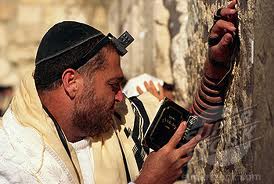
Talk about taking things literally.  Moses told the people to hold so fast to the word of God that it would be bound at their wrists and on their foreheads, and still today the Orthodox Jewish man prepares for prayer by binding actual little boxes at his wrist and forehead, with tiny scrolls from the book of Deuteronomy inside them.   These phylacteries have served as prayer companions—Catholics would call them sacramentals—since at least the time of Christ (Mt. 23:5).   They signify that the wearer has taken the Word of God into his heart and soul.

What would it be like if we Catholics wore our faith on our sleeves like that?  Of course there are a few outward signs of our inward faith.    We place a crèche on the lawn during the Christmas season and wear ashes on our foreheads at the start of Lent.

These are signs to the outside world (and reminders to ourselves) that we are indelibly marked by Christ.  But my friend Vincente asked me a great question the other day: why don’t we Catholics make more of a mark on the culture than we do?  Why do we absorb the culture so much and correct the culture so little?

Why are we proud that, after a lifetime of Catholic formation, we can go out into the workplace and blend in so well that no one would ever guess that we are Catholic?

How unsettling to wonder if, after a lifetime of lukewarm “face time” in church, we will come before Christ at our deaths and he will say I never knew you.

What do you think is an authentic outward sign of your faith?

What would YOU like to say about this question, or today’s readings, or any of the columns from the past year? The sacred conversations are setting a Pentecost fire! Register here today and join the conversation.

I have come to light a fire on the earth; how I wish it were already burning (Lk.12:49).

4 Comments to “Ninth Sunday of Ordinary Time – Cycle A”

  1. I’ve always been uncomfortable with aggressive evangelization that seems unconnected to faith in action. I think there is so much more I can to do be a person of love and peace in my daily interractions with people. It’s a simple thing, but if I can strive to always lift other’s up, NEVER gossip or speak ill about another (even little things) and never make it easy for others do the same – I think that is HUGE. It’s so hard for me to be completely consistent with this – IMAGINE the change it could make!

  2. I think the most important way we can present an outward sign of our faith is to be present to the people we encounter every day, everywhere. Open a door for someone whose arms are full of shopping bags. Listen to someone’s problems without trying to fix them. Drive an elderly person to a doctor’s appointment or on errands without acting as if you’re doing that person a favor.

    Look at doing something for another as a gift to yourself, because it is an opportunity to demonstrate your faith.

  3. “…blend in so well that no one would notice that we are Catholic?” – – Personally, I am not that interested in “getting points for being Catholic” because the Christian work that we do, whether ‘explicitly invoked as Catholic or not” still redound to the honor and glory of God. St Francis says preach the Gospel all the times and if necessary, use words. Having said that, it does not preclude our ‘tooting our horns’ if and when the circumstances call for it to answer queries by others as to our internal motivations and faith background. But imagine the opposite scenario if the more than 300 denominations, sects, faiths, religions, etc. would be waving triumphalistic religious banners and innumerable signs and billboards to proselytize directly or indirectly whenever a good deed is done? – – Cris

  4. There are some outward signs such as medals, crosses, and my Sisters of Charity Associate medallion that come to mind. But, other denominations wear some of these items and they are symbolic of Christianity more than Catholicism. I agree with Teresa that our interactions with creation are the most important outward sign of our faith. Having a smile for each person we meet, listening with a true presence to those who need to be heard, understanding the cultural differences that make up the diversity in our society, accepting people where they are, speaking out against injustices for those who have no voice is a beginning. Living the Gospel, asking Christ to help me be better at living the Great Commandment and asking for forgiveness when I fail to be the best I can be in that regard; that’s the outward sign I strive for and am not so concerned that it screams “I am Catholic”, but rather that Christ lives within my heart and soul; that I love all God’s creation and make an effort to grow in my ability to be the co-creator in this evolving universe that he has created me to be. Years ago Fr. Pat asked us to question if we feel we are a better person this year than we were last year, and that has stuck with me like glue. So, from the beginning of the year until Easter, that’s the process I use. It’s always disappointing to find so many areas where growth has been less than my goals, but certainly is a motivator for the future!!

Leave a Reply

You must be logged in to post a comment.

Eighth Sunday of Ordinary Times – Cycle A

26 February 2011

Reflecting on Matthew 6: 24-34

You know, tomorrow really does have a way of taking care of itself.  Weeping endures for the night, but in the morning comes a certain, unnameable peace.  Today is the tomorrow we worried about yesterday, and it’s just almost never as bad as we pictured.

They neither toil nor spin

But that doesn’t stop us from worrying the problem to death.  If we keep circling in on it, touching its tender corners, re-thinking our conversations, rewinding our what-ifs, maybe we’ll find a crack large enough for us to slip our hand through and re-shift the orbit of the earth and get us back to yesterday, before we found the lump, before we bought the expensive house with the balloon payments, before we hit the gas instead of the brakes, before we canceled the insurance policy.

Whew.  Just writing down a few things to worry about makes me start worrying all over again.  But then I hear those comforting words of today’s Responsorial Psalm (62):  Only in God be at rest my soul. God is my stronghold, my safety.  I shall not be disturbed at all.

But wait.  Not so fast.  Can God be trusted?  God’s grace has been sufficient and even abundant in the past, but is that enough to take to the Bank of Tomorrow?  Maybe it’s like using a muscle.  The more we trust today, the stronger and more enduring is our ability to trust tomorrow.

So get out there and consider those lilies.  Or, better yet, winter wheat.  Or the silent snow.  Or your own buttoned-up heart.  There is a wisdom out there, whispering in the February chill.  Trust in me, oh my people.

In what ways does your faith build on past experience?

What would YOU like to say about this question, or today’s readings, or any of the columns from the past year? The sacred conversations are setting a Pentecost fire! Register here today and join the conversation.

I have come to light a fire on the earth; how I wish it were already burning (Lk.12:49).

7 Comments to “Eighth Sunday of Ordinary Times – Cycle A”

  1. How do we know that worrying won’t extend our life?

  2. Oh, this is a trouble spot for me. I worry a lot. I know that I should not. I work to trust more completely in God. The panic attacks come though, and they keep me awake. But … I won’t give up. I pray for the strength to trust, I pray for the faith to trust. I pray that I will truly know that it will all work according to God’s will, even if that means I will have to go through some difficult times.

  3. I lean on Hebrews 11 when it comes to discernment/discussion about faith, especially verse 1 that indicates that “…faith is the evidence of things not seen” – – which is the antithesis of blind faith. Then for the next 39 verses, the proofs are hammered into our heads. – – Cris

  4. I constantly remind myself that worrying is a sin….it puts energy into something and takes away energy, and praise, from God! I have to remind myself from time to time to not worry, or have faith in God. But, the best reminder is to think of what has God done for me!

  5. Wow! That’s the first time I’ve ever heard that worrying is a sin.

  6. On Sunday, Deacon Kevin gave a wonderful homily on trust.As usual,when you desperately need to hear something, it is as if you’d never heard it before.
    My Mama always said, about everything, “Si Dios nos da licensia”, or if God wills it. I pray always to have that kind of faith and trust, to just rest in God.
    Today I am trusting. Tomorrow — “si Dios me da licensia”

  7. “My God, My God, Why have you forsaken me?” I’ve said those words more than a few times in my life! It might have been when I was a child and didn’t get a very good birthday present or as a teenager when a cute guy didn’t want to date me. It could have been when my daughter was diagnosed with a heart problem that needed surgery or my favorite uncle was diagnosed with cancer. It could have been when my husband walked away from our marriage after 33 years. It might be now when I contemplate how I deal with the disease of alcoholism in a loved one. Whatever the turmoils (and sometimes they are many), I too often forget to trust in God that he will supply me with the path to take. (I am an EXTREMELY SLOW STUDY!!!) I don’t know why…I survived the birthday present and the heart surgery and even the divorce. I know today, however, that these victories weren’t just MY victories but truly God’s! It was God that opened my heart to tomorrow. It was God that supplied the strength and the wisdom to persevere and with those tools…faith continues to grow! Thank you God for all the lessons! I’ll keep studying! See you tomorrow…

Leave a Reply

You must be logged in to post a comment.

Seventh Sunday of Ordinary Time – Cycle A

19 February 2011

Reflecting on Matthew 5:38-48

He offered resistance to evil

You have to wonder about Jesus’ instruction to offer no resistance to one who is evil. What would have happened if Hitler had been killed during the war? Was it morally wrong for Claus von Stauffenberg (a Catholic) to enlist the aid of thousands of other Christians (including Lutheran pastor Dietrich Bonheoffer) in an assassination attempt in July of 1944?  Records show that none took their resolve to break the fifth commandment lightly.  All had considered the millions still to be killed in the war and were willing to face God with their decision.

But no, the briefcase bomb was accidentally shifted and Hitler wasn’t killed. The Nazis quickly rounded up almost 5,000 conspirators and murdered them over the remaining 10 months of the war.

And yet today we hear Jesus say Turn the other cheek.  Walk the extra mile.  Hand over your cloak as well. Is there any wisdom out there to help us read this passage?  Plenty.

Here’s an interesting take on the text from Scripture scholar Walter Wink, who has written extensively on this issue.  He suggests that Jesus is offering some ingenious examples of passive resistance.

If a Roman occupier forces you to carry his weapon one mile (the limit by Roman law), then carry it two and put him in the brink for breaking the law!  If he slaps you on the cheek (a sign of his authority over you) then turn your cheek to the other side, forcing him to use his fist, which is the sign of your equality with him.

If he takes your tunic (only allowable for the day, not the night) then give him your cloak as well!  Stand naked in front of him and humiliate him in front of the guys.

What do you think of this?  How do you interpret the passage, what do you think of the assassination attempt on Hitler’s life which was instigated by believing Christians, etc.  This is a great text for conversation this week!  Jump in.

Does this passage trouble you?


What would YOU like to say about this question, or today’s readings, or any of the columns from the past year? The sacred conversations are setting a Pentecost fire! Register here today and join the conversation.

I have come to light a fire on the earth; how I wish it were already burning (Lk.12:49).

15 Comments to “Seventh Sunday of Ordinary Time – Cycle A”

  1. This scripture is very hard to understand. I know that it also must be very hard on the military when they must kill to protect others.

  2. Walter Wink’s ideas of how to interpret Jesus’ passive resistance suggestions are just that–passive resistance. Using a briefcase bomb is hardly a passive resistance modality, but one I could embrace and would be willing to “face God” with. A general rule of ethics is “the end does not justify the means”. Some ethicists even say “the end NEVER justifies the means”. Then there is the “just war” ethical justification argument. Having recalled these, what do you read/think was Claus von Stauffenberg’s, a Catholic and Lutheran pastor Dietrich Bonheoffer’s ethical justification in an assassination attempt in July of 1944?

  3. Many years ago, shortly after Colorado passed the first “legal” abortion law, I was working in a hospital on the labor and delivery/nursery floor. A saline abortion had been performed and the baby was placed in stainless steel bowl and placed in the dirty utility room where the “products of delivery” were ground up in the garbage disposal. A nurse walking by heard a fain cry and realized that the “product” was alive. She rushed the “product” to the nursery where I was working at the time. Suddenly, the “product” became a tiny, tiny infant boy! At the time he was only 3 pounds (Very small in those days)To make a long story short…the doctor refused to see him, there was great discussion on what we could and could not do, the baby died and the real ethical question…should he get a toe tag?

    After viewing and participating in the 3 hours of that baby’s life, I was forced to question life down to its very basic elements. It took awhile, but in the end I realized what Jesus was saying in Matthew 5. Abortion (ALL), murder, capital punishment, eutheasia, and war have no justification! These ideas were challenged when I worked as a nurse in a prison, when friends died in Vietnam and people were masacred in Darfor.

    As usual, Jesus gave us the answer. It is forgiveness. He gave us Ghandi and Martin Luther King Jr. for witnesses to his ideals. He gave us a free will to choose and he taught and showed us how/to forgive. Will all of this help make me perfect? Not yet! I really don’t think I can be perfect yet. Forgiveness is a difficult virtue. I’m gonna keep on practicin’ though…Practice makes perfect!

  4. “Love your enemies and bless those who curse you” – – to this date, when I read parish bulletins, there are notices to pray for parishioners who died, for members who are sick, etc., etc., but not a single entry on praying for Al Qaeda, Bin Laden, Arab Dictators, etc. Silence is deafening.
    It marginalizes Jesus’ teaching as irrelevant. Our churches handle the directive as “homiletic hyperbole.” – – Cris

  5. I believe that Jesus displayed exactly what he meant in this passage when he asked his father to”forgive them for they know not what they do”. Jesus asks us daily to do the hard things for him. At the most basic level we need to take the hard road. It is easy to say I love you to people we know love us, but to be harassed by people, and still pray for them, that is following in our lords footsteps.
    Since the actual commandment is “Thou shalt not murder”, I chose to follow in my lords footsteps. You can murder a person figuratively, or literally, remember the tongue is one of the most vicious weapons on the planet. I, for myself, will work on my small world of infuence, and hope that I can make a difference that spreads like a ripple in a pond. One small action, addressing a larger mode.

  6. This is such a difficult scripture passage, with so very many layers… The part that always jumps out at me is,
    “that you may be children of your heavenly Father,
    for he makes his sun rise on the bad and the good,
    and causes rain to fall on the just and the unjust.” I am always moved by this, by the overwhelming love of God pouring forth toward all of us. And so I wonder, who will we meet in heaven? Hitler, Bonhoffer and 6 million Jews; Martin Luther King, James Earl Ray and men of the Ku Klux Klan; Gandhi and his assasin. We are all beloved children of a glorious and forgiving God. How do we make sense of that kind of love in our heads and our hearts?
    Jesus is the ultimate example of how to live, and suffer and die, in the most profound model of passive resistence in human history. He never challenged the authority of Rome or the Sanhedrin, he tried to show us a different way, a new way ~ “love your enemies and pray for those who persecute you.”
    As for the question regarding the Christian involvement in planning the assassination of Hitler, I just don’t know what I would have done if I had been given the opportunity to stop such madness. I have always held those courageous people up as incredible examples of how the Christian community was called to respond, as opposed to the Vatican, which just kept silent. Maybe the lesson lies not in the rightness or wrongness of that one decision, but rather in the acknowledgment that we are called to respond to those day-to-day injustices which ultimately lead to war, prejudice, poverty, discrimination, etc, etc, etc.
    As Anne said so beautifully, working in our small world of influence, one small action at a time, we can truly make a difference in the world.

  7. There’s something to be said for defending the innocent or those who cannot defend themselves. Hitler’s determined destruction of a people needed to be stopped. He was a charismatic leader who drew people to himself and had so many convinced of the rightness of what he was doing. Does one stand silent and passive in the face of such evil? It would have been wonderful if someone were able to capture Hitler and bring him to justice in a court of law, put him in prison for genocide and throw away the key. But that wasn’t about to happen. My ordinary method would not be murder or assassination, but what mother would not protect her child? What stronger person does not come to the defense of the weak? What righteous nation does not come to stand with another against an aggressor?
    Dietrich Bonheoffer has been a hero for me since the 80’s when I first encountered his life through a professor I had. He faced an enemy stronger than himself and in the end gave up his life. He didn’t just sit around and hope that someone else would fight the enemy. He recognized a personal responsibility to stand with those who were being attacked and annihilated. Would I conspire to assassinate? No. I don’t have the courage to face the consequences on any level. I truly believe that it was in prayer that Bonheoffer made his decision against a greater evil. I’m reminded of Judith who slew an enemy of her people, of God’s people, and of Esther who saved the Jews by finally informing Xerxes of the plot against her people. Joshua and David fought for God’s people by leading armies against other armies.
    The brutality directed toward Jesus shows us how it is possible to turn the other cheek, to stand silent when being condemned to death. Yes, it is the ideal. I also see Jesus as assertive, someone who would protect his sheep against the wolves, the children against anyone who would harm them. He stood quietly and comes across as showing passive resistance but he also was aggressive when it came to his Father’s house.

  8. Reflecting on Matthew 5:38-48 does trouble me in the sense that it depends on whose cheek gets smacked first…mine, that of a loved one or that of someone who deserves my defense. I didn’t get the feeling that Jesus was allowing us that latitude. I’m certain that in the latter two situations I would make certain the perpetrator wouldn’t be able to strike a second time, regardless of what it took to guarantee that.

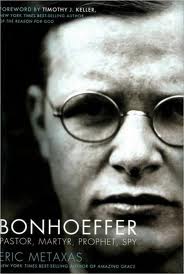
    Your mention of Bonhoeffer got my attention because I’m currently reading Eric Metaxas’ book on his tragically shortened life and am about 150 pages into the 500+ pages. He is just starting to become concerned about the rise of Hitler and his Nazi hoodlums. How could anyone turn the other cheek to that brand of scum or to the warlords that dominated Japan and set the entire Pacific on flame?

    I was in my freshman year of high school when the Nazis over-ran Poland in short order. Our fortunes in the Pacific were just starting to brake their downward course when I graduated from high school. Within a week I was in a Navy uniform hoping to help further brighten those fortunes on both fronts. There were no heroic, noble aims there, just high school emotions spilling over. The angels sitting on my shoulder at the time determined I wouldn’t get to sea until after the fighting had ceased.

    As fate would continue to pull the strings, about six years later I was serving on the very ship where the WWll surrender was signed. The Navy recalled a large number of officers from the inactive reserve ranks to active duty during the Korean conflict. In my role as a fire control officer on the USS Missouri, making certain we were hitting the targets with our 5 inch and 16 inch guns was my primary job. Those targets were primarily inanimate, consisting of rail lines along the Korean coasts and military supply depots that could be reached by our guns.

    There was obvious unavoidable human injury and death involved but at the time we were concentrating on driving the Chinese off the Korean peninsula and to bring the North Koreans to their knees and out of the South Korean territory. We were very careful to keep our artillery barrages clear of obvious civilian habitation but the military personnel were of no concern. I don’t think the distinction we made in this respect would pass Jesus’ critical eye. Neither our Catholic nor Protestant chaplain made reference to that passage during our shipboard services…I had the greatest respect and admiration for both those gentlemen.

    To have lived up to his admonitions in that passage I would had to have pleaded as a conscientious objector as would every other person when the draft board came calling. I and most of the others didn’t wait for that call. It’s impossible to even visualize the turn history would have taken by turning the other cheek under the circumstances of the time. That scenario would make a very interesting story in the hands of a gifted writer such as Metaxas.

  9. Thank you all for pouring out your hearts in your comments. It’s moving to read the feeling each has offered.

    As for Walter Wink, he is wrong. If you read the tone implied in these actions, you will see them as completely inconsistent with the life of Jesus conveyed in the rest of the New Testament. Jesus is teaching humility.

    As for the assassination attempt this was a choice that brave men and women made in a terrible time in our history. And I will not judge it. Should we ask the same question of the few men who made the decision to drop 2 atomic bombs on Japan? We can never fully understand what any of these people faced.

  10. I agree with you, Chris, about Walter Wink’s interpretation…it sounds more like passive aggression. Jesus, when he had excruciating and humiliating things done to him, prayed in Luke, “Father, forgive them, for they know not what they do.” In his responses to torture and abuse, he didn’t have as motivation an intention to hurt back. It seemed like he just held the truth in his heart and that gave him quiet and strength.

  11. Love. “If Just to Be is a Blessing;Just too live is Holy.” Abraham Joshua Heschel. Love your nieghbor. Jesus taught us to love one another and he means for us to love those who wrong us, hurt us, betray us and abuse us. Life is simple but it is not easy. Each and everyone of us is faced with “trials and tribulations” and in these when we seek to allow Jesus Christ to guide us, direct us and teach us, we can face evil and resist it and be protected by God. With Jesus Christ We can face our truth and learn that the “truth shall set you free”…..it is all about trusting Jesus Christ and seeking his word to find meaning in our life and to go forth in action. WE all make choices. God knows our hearts and the causes and circumstances of our life…..he calls us to love one another…..its in knowing who we are in Christ Jesus that enables us to resist evil, to turn the other cheek, to hand over your cloak and walk the extra mile. Pas con Jesus Christ

  12. I have to wonder if the Roman occupier got the message that he was being humiliated and mocked. I keep seeing Gandhi in the movie rendition, and his followers walking against their occupiers, one by one being beaten down with clubs. It was a peaceful resistance but bloody just the same. Such courage on the part of the leadership and followers.
    But I have to agree, what would have happened during World War II if those brave people hadn’t fought and even done drastic things that their souls had to live with.

  13. Brother Mourning Dove

    The challenge you’ve given us is a good one. Bonhoeffer had corresponded with Gandhi and 99% personally agreed with him in regards to his philosophy of nonviolence, especially as it is rooted in the sermon on the mount. Our problem with Jesus’ preaching is we are looking for formulas that are universally applicable for conflictual situations. “Too bad, so sad” as our teens say. If we know anything about Jesus’ lifestyle, teaching and witness, it is that he was thoroughly nonviolent, but we balk at this by accepting “Just War Theory.” This theory was taken from Aquinas, who got it from Augustine, who got it from Ambrose, who got it from Cicero who got it from ancient Roman law. It is not based on scripture or revelation but the historical Catholic Church [hierarchy] bought into it, was accultureated into it. Mostly the “just war” ideal has been abused, misused and been misunderstood as a rationale for “less violent” behavior. It opens up a larger argument, too big to map out here. But I will offer that in this world as it is, we must decide whether we will wage peace or wage war and then pay the price to make your ethical ideals real in practice. I believe that Bonhoeffer was nonviolent in principle but was willing to face the radical exception. Most people have little clue as to the discipline with which he practiced his own nonviolence. I can only wonder what I would do and pray that I am not faced with such horrible alternatives. But maybe we are being faced with similar choices today.

  14. Jesus says, “Be perfect, as your Heavenly Father is perfect.” I don’t mean to contradict my earlier statement, but to add to it. When I first heard that verse, I couldn’t believe it; could it really be what He is asking? But in the whole of the Bible we are told that the Father is a forgiving God. I think this trait that I know about the Father helps me to read this verse in Matthew. I am supposed to look to God, Whom I am supposed to aspire towards, and try not to cross the line from forgiveness of self when I fail to making excuses….make sense?
    Something that someone wrote too struck me in the the heart. He wrote that he would never judge the decisions or actions of Bonhoeffer. How deeply I feel an agreement with that.
    Scripture has so many balancing truths…thou shalt not kill, but you are not to judge your neighbor, etc.
    I thank God that we are actually graced to ponder these truths and glimpse a little of Him in them.

  15. In the Sermon on the Mount, Jesus Christ is telling us to not return evil with evil, injustice with injustice – but rather, to return evil and injustice with forgiveness and love. This is precisely what Jesus Christ did for us when he took our sins to the cross (he who was innocent), saying “Forgive them Father, they don’t know what they’re doing.”

    To forgive and to love in this way – to love the enemy, the one who persecutes us – is impossible for us to do with our own effort. It is only possible if we have the spirit of Christ dwelling in us. Only then can we fulfill the Sermon on the Mount, without effort, because we have the Holy Spirit dwelling in us.

    The spirit of Christ is a spirit that has overcome death – a spirit that has conquered death. This is a spirit that gives eternal life – that we do not die. It is this spirit that has allowed the martyrs of the Church to give their lives, going to their death singing and praising God, because they knew it was not they who were suffering and dying, but the victorious spirit of Christ dwelling in them.

    To follow Jesus Christ is to follow Him to Jerusalem, to be crucified for the salvation of the one who persecutes us. This is the way of the Servant of Yahweh (of Isaiah). This way of loving and dying is the mission of the Church – to save the world.

Leave a Reply

You must be logged in to post a comment.

Sixth Sunday of Ordinary Time – Cycle A

12 February 2011

Reflecting on Matthew 5: 17-37

The Gospel today is so refreshing because it’s so in-your-face about the way we try to squirm out of really living it.

You are the light of the world

Don’t show up with your offering if you’re still furious with your brother.  Don’t be slimy about your fantasy life with people not your spouse and still pretend that you are faithful. Don’t do mean and unethical things just because nobody is watching (really?) or because the law hasn’t noticed your tax evasions yet. Don’t do just enough to not get caught, love just enough to keep up appearances, swear on anybody’s dead body.  Truth is truth and a lie’s a lie, so just tell the truth for heaven’s sake.

Here’s how the believer behaves, says Jesus.  Do the hard and holy work of reconciliation. Be faithful in your private life, and oh how your light will shine in public. Let your actions spring from authentic love.  Don’t watch the clock.  Don’t ask if there’ll be a test on the material.  Do fulfill the Law by abounding in love.  In fact, just love, and then do what you will.

Think of the children whom you love fiercely, whom you want others to love and give the benefit of the doubt, to whom you hope the world will extend friendship and compassion. No half-teachers, half-friends, half-loves.  You know how you want them to be loved.  Now go, says Jesus, and love like that.

Whoosh!  Did you feel that?  It felt a lot like the fire of Sinai, carried like an Olympic torch by you, the light of the world.

Are there ways in which you are just putting in the time instead of actually investing in love?

What would YOU like to say about this question, or today’s readings, or any of the columns from the past year? The sacred conversations are setting a Pentecost fire! Register here today and join the conversation.

I have come to light a fire on the earth; how I wish it were already burning (Lk.12:49).

6 Comments to “Sixth Sunday of Ordinary Time – Cycle A”

  1. I have felt the calling to change my life since this summer, after reading “Mother Teresa’s Prescription” and Father Michael Scanlan’s book Baptized by Fire. Both books are a call to action. Very clearly Mother Teresa did not call on us to take up a sword, but to simply focus on those in need. What a simple thing, to look at someone else’s needs rather than ours! By doing so, we are looking at the gospel, loving the way Jesus taught us to love.

  2. When I first heard Matthew West’s song “The Motions” I sat and cried. It’s been a motivating force for me ever since. Kathy’s comments about half-friends, half-loves all the other halves in life brought me right back to that moment.
    Matthew sings,
    “I don’t wanna go through the motions
    I don’t wanna go one more day
    Without Your all consuming passion inside of me
    I don’t wanna spend my whole life asking
    What if I had given everything?
    Instead of going through the motions”
    What is it like to have the all consuming passion of God alive and active inside of me, in this community, in this world? What would it be like to go beyond the half-way mark in relationships, in service, in giving of myself? What would it be like to go the “extra mile,” instead of stopping short? Sometimes I think I do, but there are those other times….
    Years ago, a friend of mine asked me what I was passionate about and I didn’t know. It felt so sad to sit there wondering rather than have passion jump out at me. Since then, my attitude has changed to allow me to recognize what gives me goose bumps, what causes me to give it everything I have and am. Recognition seems to be part of the passion. Gratitude helps me grow in love and calls me to invest myself even more. I don’t want to just go through motions; I want to be fully present. I don’t want to let this moment in life to pass me by. I want to live it. I want to love the people who come into my life through every day experiences, through the prayer network, through the newspaper, through the cashier line at the grocery store, through the lanes of traffic on I-25. I want to love the people who are on the wayside or who stand in the margins, those who are poor and oppressed, lonely and weary. And not just half-way, but all the way. Because what would my life be like if I really did give everything to it?

  3. years ago, a priest lectured our high school class about “going all the way”. At the time, free love and everything else free ruled the world we knew. “Going all the way” described having sex with the person you loved. Giving all to a single individual that you wanted to be with forever!!! (Like ANYBODY really knew at age 17 who they really wanted/needed/loved/lusted/etc!)

    This very wise priest taught us all that “going all the way” wasn’t sleeping with that ultimate “soulmate” but waiting and following the Church’s rules about premarital sex and the sacrament of marriage.

    Fast forward some 40 years. We have all had “life” experiences. Some of listened to that priest, some of us didn’t. The lesson we take away from it is still the same. “GO ALL THE WAY!” Commit to God in our lives! Go all the way in your job, your family, your relationships, your passion, your hobbies, even your football team for Jesus wants us to LIVE! and one can only live if they open their heart, mind, body and soul to God/Love. P.S. Thanks God for the Green Bay Packers…just sayin’!

  4. All I know is that I am not there yet, “there” being the perfect gift of 100% love and dedication.
    BUT when I read the entries here of all my faith cyber friends, I feel the boost to move a little bit more each time. So, thank you everyone. – – Cris

  5. This is one of my favorite readings. I completely agree with “Truth is truth and a lie’s a lie, so just tell the truth for heaven’s sake.” I’ll just add that to me the verses on “yes meaning yes …” is about personal integrity and constancy of character. Dare to be a real person who is full of truth and radiates integrity.

  6. I don’t have anything to add to these beautiful reflections, but wanted to thank those who wrote for your rich, wise words. So much to think about.

Leave a Reply

You must be logged in to post a comment.

Fifth Sunday of Ordinary Time – Cycle A

4 February 2011

Reflecting on Matthew 5:13-16

Darkness. The ancients experienced it in ways we can’t imagine.  My friend Erin told me about a scary twenty minutes of her life in a blackout one evening while she was walking home from work in Oakland, California.  She was just a few blocks from her house when the street lights went dark.  (This, by the way, is the same city in which my cousin was murdered in daylight as she was getting off the city bus 18 years ago.)

All these years later, Erin remembers that penetrating darkness, how immediately she became uneasy, then jumpy, then terrified as she walked the dark neighborhood streets she knew so well.  The lights from an oncoming car brought a few seconds of clarity.  Of course! That scary figure up ahead is just the open gate to the neighbor’s yard! But then she was plunged into darkness again as the car sped away, and those familiar streets morphed into sinister hiding places for ugliness and evil.

Some people, as Thomas Merton said, are walking around shining like the sun.  Every encounter with them makes you feel warm and loved.  They are found everywhere, little rays of light adopting children from Haiti, helping gang members recover their lives, getting up at night with the sick baby, loving that troubled adolescent, joyfully teaching the grandchildren their prayers, sitting with the parent who has long forgotten their name, preaching the Gospel and sometimes using words to do it.

And here’s the best part about being the light of the world: Isaiah says that when you shall call, the Lord will answer.

Who are the people you know who bring light?

In memory of Patty Cronin, a light-bearer

What would YOU like to say about this question, or today’s readings, or any of the columns from the past year? The sacred conversations are setting a Pentecost fire! Register here today and join the conversation.

I have come to light a fire on the earth; how I wish it were already burning (Lk.12:49).

4 Comments to “Fifth Sunday of Ordinary Time – Cycle A”

  1. After spending time savoring last week’s wonderful reflections, I heard today’s gospel and readings in a whole new light. My guess is that all of us easily thought last week of half a dozen mortifying moments we’ve experienced; and I have no doubt that we can all think now of at least TWO dozen people who are bringers of light.

    But this gospel poses a more difficult question for me. Christ doesn’t say we will BECOME the salt of the earth or the light of the world. He says that we already ARE those things, just exactly as God has made us. Imagine that. With all our faults and weaknesses, with all that makes us small in our own estimation, Jesus can still look into our hearts and say that our lives — my life — can bring glory to God … if only I have the courage to live my truth. Setting my lamp on a stand to bring light to the whole house is NOT about making a show of virtue or trying for some unreachable standard of holiness. It is simply to know who I am, to love that self with patience and humility, to live authentically, and to recognize and enable that dignity in those around me.

    It seems to me that the opposite of being salt for the earth and light for the world is to fall into the trap of false humility, even more than not utilizing the gifts we have been given. So maybe the better question for me this week is to recognize where I bring light in some way to the lives that touch mine each day. To humbly thank God for my gifts. To praise God for working through me.

    So this week, I will hold Kathy’s wonderful reminder close to my heart: “God is God, and I am not.” But I will rejoice that God has chosen me to reflect his glory anyway. Because it is Jesus who tells us this is so.

  2. Kathy,
    Who is Patty Cronin?
    Cris

  3. Thank you, Cris. Yes, Patty was my extremely kind, gentle cousin. She was shot in the back while running from an assailant just after she had gotten off a city bus in Oakland. She dropped her purse immediately, but he killed her anyway.

    Patty loved Marianne Williamson, and was on her way to her class in A Course in Miracles. It gives me peace when I remember that she was running in the direction of God when she was killed.

    How nice of you to ask.

  4. Kathy,

    I am so sorry about your cousin. What an awful pain that is in your heart! I love the image you portray of her “running in the direction of God when she was killed.” Bless you for sharing this painful memory with us.

    On my way to perfect . . .

Leave a Reply

You must be logged in to post a comment.

Fourth Week of Ordinary Time – Cycle A

29 January 2011

Reflecting on Matthew 5:1-12a

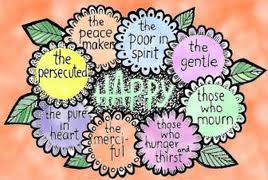
I’ve experienced the blessing of being poor in spirit several times.  There was the day I sang a whole wedding Mass with the back of my skirt hooked on to my pantyhose.  Or the time I chose a lovely silk smock from the hanger at the hair salon, and as the stylist was putting my head in the water an exceptionally kind older woman touched me on the shoulder and said, “Honey, I think you’re wearing my blouse.”

I could do this all day.  My life is a series of horrible moments that have brought me this self-revelation: I am just faking it here.

And that’s the blessing.  The kingdom of God is just this: a deep and joyful awareness that God is God, and I’m not.  Scripture scholar Reginald Fuller said, after studying today’s reading from Zephaniah and the Gospel’s Beatitudes, “on the day of the Lord the only ground of security is humility.”  Not self-hate.  Not breast-beating.  Just the awareness that, at any moment, the world will see that We are just faking it here. But God upholds us and strengthens us.

Try to bring back an embarrassing experience.  Hold it.  Let it take your breath away again.  Bow your head under its terrible weight.  And now wrap it around you as a warm coat, a safeguard against the cold winds of assurance, arrogance, superiority, dominance.  And let the blessing warm you like a peppermint schnapps’ by the fire.  God is God and you aren’t.  Whew.  What a huge relief.   What a burden lifted.  What a blessing.

In what ways has a humbling experience blessed you?

What would YOU like to say about this question, or today’s readings, or any of the columns from the past year? The sacred conversations are setting a Pentecost fire! Register here today and join the conversation.

I have come to light a fire on the earth; how I wish it were already burning (Lk.12:49).

8 Comments to “Fourth Week of Ordinary Time – Cycle A”

  1. Well, Kathy, if you’re “just faking it here,” what hope is there for the rest of us?

    Rather than seeing it as “faking,” I prefer to believe that we are all just on the way — the same as the original 12 disciples. Look at the mistakes of St. Peter and gain courage and hope!

    Lately, when people ask me how I am, I’ve begun to reply, “On my way to perfect!” Aren’t we all supposed to be working toward that? Not that we are, by any means, but, as one of my favorite priests used to say, “perfect” means “on target.”

  2. Oh Kathy, my friend… You hit the nail on the head for me and my life. For me, the way to be closer to the Divine is through utter humility, which is sometimes utter humiliation. It’s really letting go of all the stuff I use to define myself and my life, trying to stand naked in front of God. And when I get a bit too confident that I’m in control, I am humbled by the world around me and reminded that I really don’t know very much at all. The mantra that helps me so very much is the one you quote (and which I learned from you!), “God is God and I’m not.” Wow! What a relief that is… I don’t have to be God, or like God, or aim for perfection. I get to just be me, in front of our Living God. And when things get too hard or scary, I close my eyes and humbly fall backwards into the arms of God ~ my Mother, my Father, my Everything.
    Thank you for sharing your humility and your light with all of us!

  3. A humbling experience? Let me count the ways, the times, and the blessings! I once ran over a friend’s foot while I was showing off my “perfect” parallel parking skills! God was with me then and continues to remind me that all of my joys and mistakes have his name and not mine on them. While I was the one running over the foot, God was teaching and watching and stregthening me for the many many mistakes to come.
    Faking it explains why I still have problems remembering that it is God and not me who should be taking the bows and the applause for the many wonderful things in my life. As for the mistakes…they give me courage to ask for God’s help thus realizing that is only through true humility that I can embrace God’s presence in my life…

  4. Karen,

    We will all be perfect someday in heaven. While we’re here, we are responsible for being headed in that direction to the best of our ability. That’s what I meant about “being on target.”

  5. I am about as graceful as a bull in a china shop! To share my many mishaps would like watching the really old slap stick shows. I learned long ago that if we take ourselves too suriously we cry a lot. What comforts me is that no matter the way the moment make our mistakes look huge, the sun will rise on another day and all will forget in time. And in time when we remember we may even laugh! God is a God of freedom, we have free will, He forces nothing on us and He opens our eyes to our imperfections so that we might remember and have compassion on one and another. I am perfectly imperfect and He loves me as He watches my struggles and blunders.

  6. Okay everybody, you’ve probably already guessed. Yes, OF COURSE I was the hapless kid standing in the street a week before high school graduation, looking the other way while Mame ran over my foot in front of everybody.

    Add that one to the list. And Mame, I’ve long ago forgiven you and I’m so glad you’ve joined our conversatio. You have riches to share.

    Kathy

  7. Kathy, you’ve started a powerful discussion. What a great way to talk about the blessings of humility. Thank you, Everyone, for the profound insights.
    I’ve been writing a lot about losing my job. It happened without any warning so I spent what seems like forever grieving. It was a humiliating experience especially when some people interpreted what happened as my being fired. For financial reasons, the position was terminated which puts a different slant on it. Still, I was out of work and feeling miserable with low self-esteem and a loss of self-worth. The longer I was unemployed, the more often someone asked me if I found a job, the more humiliated I felt.
    I have to say that for me there is a difference between humiliation and humility. The former seems to be something that happens to me from the outside. The latter is an interior disposition, an acceptance of what is true. When I changed my response to “I’m between jobs,” I felt humility rather than humiliation. It was an inner experience that allowed me to face the truth of what was.
    Now I’m employed, but being new to the job means there’s a learning curve and I make plenty of mistakes. Being a “perfectionist” I have to accept the fact that I will learn. When someone calls attention to one of my errors, I make it a point to say thank you. This is humility, accepting my gifts and limitations. The experience of losing a job and being unemployed as well as working in a position where my best gifts and talents aren’t used, teaches me both gratitude and humility, which I believe are linked. Humility teaches me that I cannot do any of this myself. It shows me how easily I can become too proud of the things I do or am able to achieve. It’s very freeing to recognize how powerful God is and how dependence on God’s providence partnered with my cooperation, leads me to the fullness of life.
    I can remember thinking that my position was secure. “This can never happen to me because I am needed.” Well, I’ve learned that I am not indispensable and that God sometimes takes us from our “good work” to teach us that we are community, dependent on God and interdependent on each other. It hurts but there is also healing in the process. The blessing is in the gift of work, the acceptance of who I am and a grateful attitude.

  8. Yes, I have been “in between jobs” and it’s a great lesson to see the “other side.” To earn the minimum wage, to work with ex-convicts, to be supervised by high school graduates, to make errors on the dispatching machine, to negotiate with cut-down working hours, etc. etc….It’s good to be with that side of humanity. – – Cris

Leave a Reply

You must be logged in to post a comment.

« Previous PageNext Page »