Ordinary Time – Cycle A

Solemnity of Saints Peter and Paul

30 June 2014

Those early Christians living in Rome were an ingenious group.  They lived in the shadow of the coliseum, that horror chamber where slaves, gladiators, prisoners, wild animals, and, depending on the whim of the emperor, Christians themselves were massacred in numbers too astonishing to even grasp.  And all of this for the “entertainment” of the public, who appear to have had no end to their appetite for gore.

Imagine living in a world where the emperor thought he was the son of the gods, and celebrated his birthday on December 25th, the feast of the Invincible Sun, a big party around the winter solstice that rejoiced in the sun gradually “coming back” to earth.  What’s a Christian to do in such a world?  That’s easy.  Decide that December 25th will henceforth be celebrated as the birthday of Christ, the true Son of God, the only Invincible Son.

What about the mythical founders of Rome, the twins Romulus and Remus?  Abandoned at birth by their human mother and their father Mars, the god of war, they were nursed by a she-wolf until adopted by a shepherd.  They went on to found Rome, but, alas, they quarreled, and Romulus killed Remus.  So the great city of Rome sprouted from the seeds of war and fratricide.  But a big party in honor of them was held in Rome every June 29th.

What’s a Christian to do?  That’s easy too.  Proclaim June 29th as the feast day of the twin leaders of the Church, Peter and Paul.  That’s how you lift up a culture.  You place Jesus in the hearts of those who want to rejoice, but need an actual reason.

What ingenious ways do you use to bring Jesus into the conversation?
What would YOU like to say about this question, or today’s readings, or any of the columns from the past year? The sacred conversations are setting a Pentecost fire! Register here today and join the conversation.
I have come to light a fire on the earth; how I wish it were already burning (Lk.12:49).

Most Holy Body and Blood of Jesus – Cycle A

23 June 2014

Reflecting on John 6: 51-58

My friend Noblet barely notices sports teams, even when her home team goes to the Super Bowl.  “What did you and your brothers and sisters DO when you were growing up if you didn’t play sports?” I ask.  “We planted wheat,” she says, and that’s when the dots connect for me.

Of course.  They planted wheat.  They and all the farmers of the world who produce 650 million tons of it every year.  And, in the planting, and cultivating, and praying over, and harvesting of this wheat they partnered with God in bringing bread to the tables of most people on this planet.  That’s at least as satisfying as hitting a fly ball to left field.

Jesus could have said I am the rice of life too, since that metaphor resonates more deeply for the billions for whom rice is the more familiar staple.  When the Hebrew children escaped Egypt (the bread basket of the world) and lived in the barren desert for forty years, God became for them the manna of life.  And, just like every farmer who watches the skies for rain, those ex-slaves watched the skies for God’s daily gift of food. 

They would have to wait for the glorious fields of the Galilee.  For now, the strange, sticky dew would sustain them.

It’s a holy thing, this planting of wheat.  We plant the seeds, and God sends the rains and the sun.  Morning comes, and evening follows, and one day, voilà.  Wheat.

And just as the lovely stalks lift up in the fields, we lift our hearts up to the Lord.  Happy Feast Day, Church, and may we ever see him in the breaking of the Bread.

How are you partnering with God to feed and nourish?

What would YOU like to say about this question, or today’s readings, or any of the columns from the past year? The sacred conversations are setting a Pentecost fire! Register here today and join the conversation.
I have come to light a fire on the earth; how I wish it were already burning (Lk.12:49).

Solemnity of the Most Holy Trinity

17 June 2014

If you’ve never been to Niagara Falls―the Canadian side, especially―you’ve missed a great lesson on the Trinity.  The confluence of the waters of the Upper Great Lakes roars over the three great waterfalls, the Horseshoe, American, and Bridal Veil, over which pour twenty percent of the world’s fresh water every year.

To stand next to a waterfall so thunderous, so eternal, so life-giving (and so deadly for those crazy enough to hurl themselves over it) is to sense the power of God.  And God is never alone, but always a relationship of Three.

Three waterfalls, pouring six million cubic feet of water over the crest line every minute, can speak powerfully about the life and strength and grace that comes from connecting our lives to other lives, and the lives that come from that.

There is nothing that exists alone.  The great gift of growing older, it seems to me, is to be more and more astonished at how interconnected we all are.  The earliest Christians got it right when they named God as Three, eternally in relationship with each other and with us.

During Holy Week, the memory of the life, death and resurrection of Jesus holds me, breaks my heart, and lifts me up.  In these weeks after Pentecost I am especially aware of the endless ways in which the Holy Spirit finds me, whispers to me, inspires me.

And when I’m standing in the mist of the Great Falls, my heart soars to the Creator of it all, who uses water―the source of all life―roaring over three waterfalls to teach the mystery of God.

In what ways do you sense God in all things?

What would YOU like to say about this question, or today’s readings, or any of the columns from the past year? The sacred conversations are setting a Pentecost fire! Register here today and join the conversation.
I have come to light a fire on the earth; how I wish it were already burning (Lk.12:49).

A Pentecost Sequence

11 June 2014

Send your fire, oh Spirit.
Not the fire of guns.  We’ve heard them to death.
Change us.  Do whatever it takes.  We won’t do it ourselves.

Not the fires of forests, dying.
Send the rains of new life, and heal the world.
Create in us a clean heart.  We can’t renew the face of the earth until you do.

Not the terror of medieval minds
Unleashed on hope-filled girls.
Fast-forward their abductors, and all who think like them,
Into a new way of being in the world.

Like a mighty wind, oh God,
Blow away our gods of stuff, and our religion of more.
Make our hearts hungry to find you in the beautiful faces of those
In parts of the world we’ve never sought.

Come, oh Holy Spirit, come!  And give us wider eyes, and humbler hearts.
Let us see the world as you see it, if we can bear it.
Bend our stubborn hearts, and will.
Change us, Spirit, now until He comes again.
 AMEN. AMEN.

How are you cooperating with the Holy Spirit?

What would YOU like to say about this question, or today’s readings, or any of the columns from the past year? The sacred conversations are setting a Pentecost fire! Register here today and join the conversation.
I have come to light a fire on the earth; how I wish it were already burning (Lk.12:49).

Eighth Sunday in Ordinary Time – Cycle A

3 March 2014

There is a moment in the long-ago television show Thirtysomething that has stayed with me all these years.  One of the main characters was an avid environmentalist who didn’t drive a car.  He rode his bike in all seasons, and his friends worried that he would be hit by a car, or slide on the ice and fall into traffic, or hit a pothole and break his ribs, or get stung on the tongue by a bee and go crashing off his bike and then skid ten yards into traffic.

No, wait.  That’s my bicyclist-husband Ben’s resumé.  The bicyclist on the show was suddenly killed off in one episode, and yes, it was a car accident, but the unexpected twist was that he happened that night to be a passenger in a car that was hit by a drunk driver.

Isn’t that always the way?  We decide on the things we’ll worry about, and devote our sleepless nights and years to them, and sometimes the things we’ve worried about happen right on schedule, but more often it’s the things we never saw coming that take us to our knees. That’s what Jesus meant by sufficient for a day is its own evil. Every day brings its own challenges, and then blessed sleep repairs our psyches and prepares us for the next day.  Or, as the Genesis author wrote so beautifully about God’s work in the six days of creation, evening came, and morning followed.

There was, of course, that anguished, sleepless night in Gethsemane, and the terrible events of the next day. But Good Friday came, and Easter followed.  Jesus has won the right to tell us to cease worrying.

Over which worries have you lost way too much sleep?

What would YOU like to say about this question, or today’s readings, or any of the columns from the past year? The sacred conversations are setting a Pentecost fire! Register here today and join the conversation.
I have come to light a fire on the earth; how I wish it were already burning (Lk.12:49).

Seventh Sunday in Ordinary Time – Cycle A

22 February 2014

Reflecting on Matthew 5: 38-48

As the Olympics come to an end this weekend I find myself wondering: What if there were an Olympics that awarded medals for individuals or nations that best perform three events put before us in today’s readings?

  • Take no revenge and cherish no grudge against any of your people (Leviticus 19:17).

Are you STILL nursing that grudge against your sister after all this time?  Get over yourself.  Review the past and see things from her perspective for once.  Disarm yourself.  Call her.  The family member who takes that advice to heart wins the gold medal, and gets the biggest chocolate bunny this Easter.

  • Give to the one who asks of you (Matthew 5:42).

On the website that accompanies this column there was an exchange last week that brought this controversial Olympic event into focus.  Due to a childhood in poverty, Becky’s basic reading and writing skills are poor.  During the past few weeks she expressed on the site a number of beautiful theological insights drawn from her lifetime of suffering.

An English teacher might be tempted to take a red pen to the errors in spelling and sentence structure.  Instead, Cris, a highly educated reader a thousand miles away, chose to read past the grammatical struggles and responded to her heart, the heart she was asking to be cherished.   It’s a tie.  They share the gold medal, Becky for having the courage to ask to be heard, and Cris for truly hearing.

  • Forget not all God’s benefits (Ps. 103:2).

When you drew open the blinds this morning did you instinctively thank God for sunlight?  Step up to the dais.  The gold is yours.

In what virtues are you training for Olympic gold?

What would YOU like to say about this question, or today’s readings, or any of the columns from the past year? The sacred conversations are setting a Pentecost fire! Register here today and join the conversation.
I have come to light a fire on the earth; how I wish it were already burning (Lk.12:49).

Sixth Sunday in Ordinary Time – Cycle A

17 February 2014

Reflecting on Matthew 5: 17-37

Now that the Jaqueline Kennedy interview tapes have been released, we know the fascinating advice her husband gave her about managing the hostility she felt toward some of the foreign guests at the White House.  He said, “Jackie, you can’t think these insulting things about people, even in private, because someday those thoughts will come slipping out of your mouth at some state dinner, and next thing you know we’ll be at war with Russia.”

How true.  Maybe that’s what Jesus meant when he said that insulting each other is like committing a murder.  Unkind words are not easily forgotten, regardless of how much we assure the contrite friend that all is forgiven.  The general trajectory of hurtful words is hurt feelings, which invariably lead the offended party to get revenge in some unconscious way.  We have no real cultural model in which to say, “You really hurt me last month, and I thought I could forgive you, but I find that I am apprehensive and hostile towards you now.” True forgiveness is hard work, and probably takes longer than we’d hoped. 

So, the way to avoid all this is to go on a fast from thinking uncharitable things about people.  This is harder to do today than ever because creatively insulting people is the national media pastime, especially in election years, and when is it not an election year? Fast from imagining some hilarious barb you would sling at someone, and chances are you never will sling that barb, which will keep them from having to come at you someday with a hatchet.

What experience have you had with the “murder” that hurtful words can cause?

What would YOU like to say about this question, or today’s readings, or any of the columns from the past year? The sacred conversations are setting a Pentecost fire! Register here today and join the conversation.
I have come to light a fire on the earth; how I wish it were already burning (Lk.12:49).

Fifth Sunday in Ordinary Time – Cycle A

9 February 2014

Reflecting on Matthew 5: 13-16

I am surrounded by light.  I can’t even remember what darkness looks like.  Every time I pick up a bulletin, every time I have a conversation with a friend, well, I am almost blinded by light.

Have you noticed that Jesus didn’t say, “Do good works and you will be the light of the world”?  He said, “You ARE the light of the world.”  YOU, right now, are a little lantern walking around in your home, your job, the soccer field, your parish.  And every time you share your bread with the hungry this huge burst of light pours out of your lantern and warms everyone around you.

YOU are the city set on the hill.  You know that enchanting, light-filled house you can see from the highway and want to drive over and see it up close?  That’s YOU.  And every time you shelter the oppressed and the homeless your house becomes even more inviting, more alluring than the brightest star, and immigrants and refugees take courage as they make their way towards it.

YOU are the salt of the earth.  You know that gracious, open-hearted, open-handed person who removes oppression, false accusation and malicious speech? That’s YOU.  And every time you stop gossip in its tracks and end conversation that is hurtful of others, YOWZER!  A gigantic salt-shaker makes everything around you delicious.  Bring on the margaritas and chips.

Want to make your city on the hill even more visible? Check out www.oxfam.org.  Want to give out more light than a supernova?  Go to www.covivo.org .  Let the Vincentian charisms wash over you, and then step back.

Break forth, oh beauteous heavenly light.

Who are there people in your life who radiate light?

What would YOU like to say about this question, or today’s readings, or any of the columns from the past year? The sacred conversations are setting a Pentecost fire! Register here today and join the conversation.
I have come to light a fire on the earth; how I wish it were already burning (Lk.12:49).

Presentation of the Lord – Cycle A

3 February 2014

Reflecting on Luke 2: 22-40

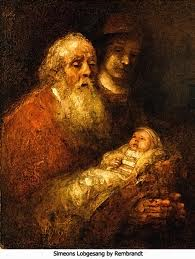
Rembrandt, Simeon in the Temple, 1669

Even though we are reading from the gospel of Matthew this year, today’s feast falls on a Sunday and therefore trumps the Ordinary Time readings.  Since two female saints, Mary and Anna, are featured in the account, you can bet that Luke is the author.  He loves to tell us stories about women, especially Mary, and we love to hear them.

This story is all about timing.  Mary and Joseph waited the prescribed forty days and then entered the Temple.  Simeon was led by the Spirit to go there that day, and Anna purposely placed herself in the Temple every day so that she could bear witness to God’s perfect timing.

Have you ever been at the right place at the right time? So often it’s only in looking back that we recognize the perfect timing that led us to our spouse, or to our friends, or to faith itself.  But much of “perfect timing” has to do with aligning ourselves with grace.  Mary and Joseph complied with the Law.  Simeon complied with the Holy Spirit.  And Anna complied with her inner knowledge that if she was to see her Savior she needed to stay in the Temple.

We live our lives immersed in mystery.  We are astounded at the perfect timing of many events in our lives.  Somehow, we intuitively sense the Divine, and situate ourselves to be receptive to the presence of Christ, visible and invisible.

It’s in that patient day-to-day watchfulness that our lives unfold.  And one day, in God’s own time, we too will say:  Lord, dismiss your servant in peace, for my eyes have seen your salvation.

What moments of “perfect timing” have you experienced?

What would YOU like to say about this question, or today’s readings, or any of the columns from the past year? The sacred conversations are setting a Pentecost fire! Register here today and join the conversation.
I have come to light a fire on the earth; how I wish it were already burning (Lk.12:49).

Third Sunday in Ordinary Time – Cycle A

26 January 2014

Reflecting on Matthew 4: 12-23

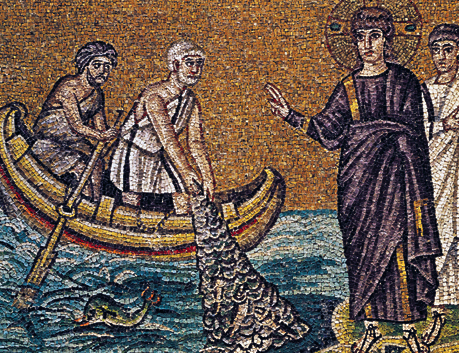
The Calling of Saints Peter and Andrew, from the Church of Sant’ Apollinare, Ravenna, Italy

And so it begins.  The Spirit hovers over Jesus, and announces his identity as God’s own Son. Soon afterwards, John is arrested and shut up in prison.  It is time, the time marked out from the beginning of time.  Jesus the Christ moves away from the comfortable Jewish neighborhoods of Nazareth and launches the Age of Grace in the Galilee of the Gentiles.

The people who walked in darkness now see a great Light.  His name is Jesus, and he is living, and preaching, and healing among them.  And he is calling them out of their boats into the greatest fishing adventure of all time.

Sometimes you just know that it’s time.  Time to grow up.  Time to move away.  Time to put away childish behaviors, petty resentments, unhealthy habits, and immature ideas about God that keep you at a safe (but so unsafe) distance from the One who is God with us.

The distance between Nazareth and Capernaum was only 48 miles.  Sometimes the greatest journeys we take are the shortest in distance, but in looking back we say, “Yes, that’s when my life changed forever.”  Jesus knew it was time to stretch out his arms to every person, Gentile and Jew, to heal and console, to catch all creation in his safe embrace, and let anguish take wing.

In time, those healing arms would be stretched out on a cross.  Did he know that when he left tiny Nazareth to catch Peter and Andrew and James and John in the net of eternity?  He caught us too, of course.  We live in gratitude for that, and hope to be his best catch ever.

What has been a significant time of transition in your life?

What would YOU like to say about this question, or today’s readings, or any of the columns from the past year? The sacred conversations are setting a Pentecost fire! Register here today and join the conversation.
I have come to light a fire on the earth; how I wish it were already burning (Lk.12:49).
« Previous PageNext Page »